
The Last -isms
Capitalism, Socialism, Communism, Transhumanism — and the Soul-Shaped Hole at the Center of All of Them

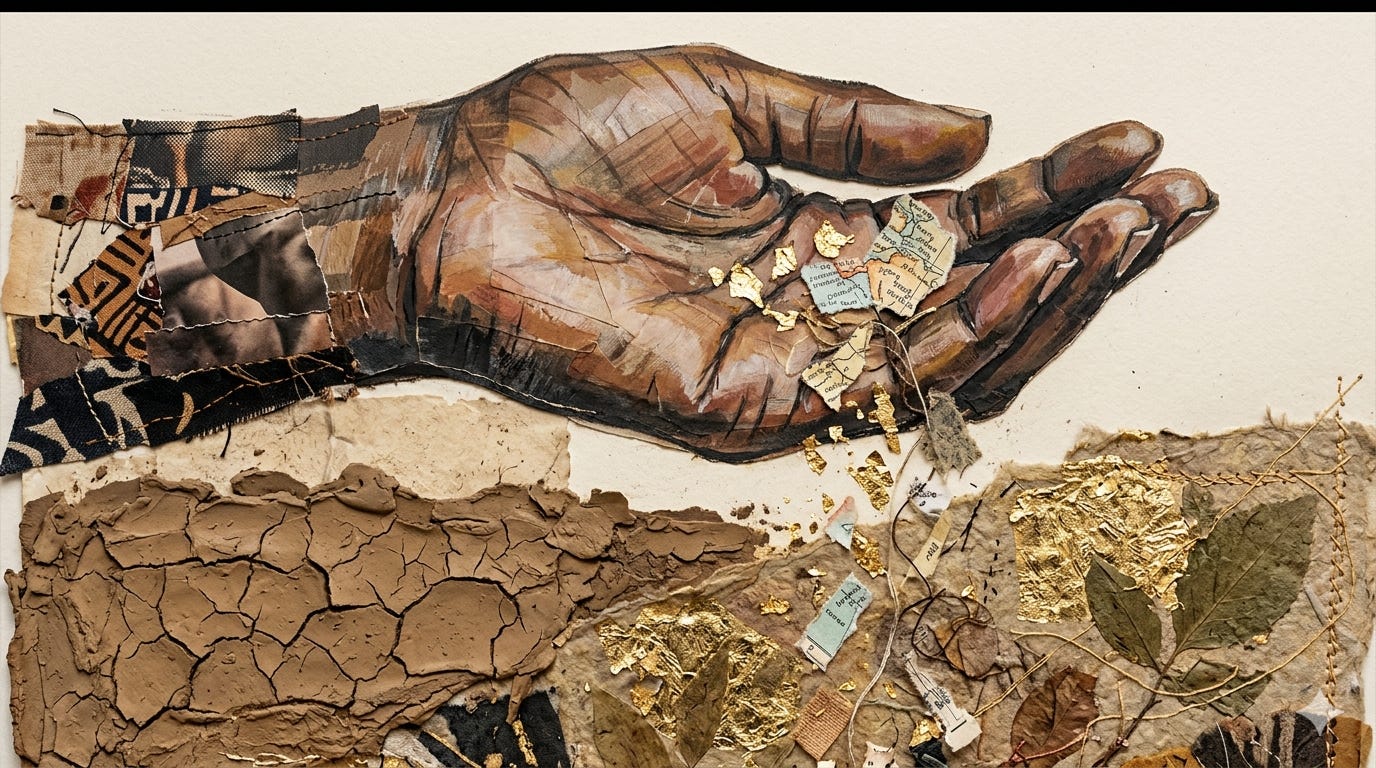
We are inside the Fourth Turning, and the four ideological frames now competing to organize what comes next — capitalism, socialism, communism, transhumanism — are all running on the same broken metaphysics. None of them can build a living world. This article is about why, and about who can.
All that you touch You Change.
All that you Change Changes you.
The only lasting truth Is Change.
God is Change.— Octavia E. Butler, Parable of the Sower (1993)
Opening verse of Earthseed: The Books of the Living
Inside the Crisis Turning
Octavia Butler wrote those lines in 1993 about a 2024 that arrived almost exactly the way she described it: a republic disintegrating, an “ascendant” demagogue rising on a “Make America Great Again” slogan, the climate breaking, and the people she trusted to build what came next being not the politicians or the prophets or the billionaires but the readers and writers and gardeners and refugees who would carry the seeds into new ground.
All that you touch you change. The verse names the law the four dying ideologies have refused to learn: that the world is alive, that we are inside it, that our touch leaves it different, that its touch leaves us different. God is Change. The dying ideologies prefer a god that is permanence — capital permanence, state permanence, digital permanence, escape from the change that everything living must do.
We are roughly two-thirds of the way through the Fourth Turning (of “Crisis) that William Strauss and Neil Howe described, the period that began in the mid-2000s and that Howe, in his 2023 update, projects will extend until around 2033. Inside that frame, the present feels less like a series of unconnected emergencies — the climate cascade, the AI inflection, the genocides, the institutional collapses, the techno-feudal capture of public life — and more like a single transition between worlds. The old structures are dying out loud. The new ones have not yet been named.
The debate over what comes next is being staged inside a vocabulary that already belongs to the dying era. The argument we keep being offered is some variant of capitalism versus socialism, or human futures versus transhumanist ones, with communism floating in the margins as a ghost of itself. The four words on the table here are presented as if they were live, competing answers. What’s actually emerging has already moved past them. They are the closing acts of the same five-hundred-year-old show, and what comes after them will not be one of them in a new costume.
The argument that follows works the four contenders down to their shared operating system, names what the contemporary intellectually-rigorous left cannot see through that operating system, examines the transhumanist seam where useful technology is being packaged with a pathological metaphysics, walks through the bridge movements — Land Back, reparations, healthcare-as-commons, planetary citizenship — and what each of them is pointing toward at planetary scale, and ends on the question of who builds the world that comes next, since it will not be most of the people currently loudest about it.
The note to put on the table before any of that: this argument has been weaponized before. The “transcend and include” move, carelessly applied, has been used to defer reparations, land return, and every other form of concrete redress in favor of an abstract eventual future. That is not what is happening here. These bridges are the new world in its early form, and the people leading them are its architects.
One more note before beginning. The closest analytical adjacent to what follows is the Conspirituality podcast — Derek Beres, Matthew Remski, and Julian Walker — whose six-year project documents the capture of New Age spirituality by reactionary politics and the structural pathologies of the wellness industry. A full profile of their work sits in the back matter.
The Last -isms
Strip the four contenders down to what they actually share, and what they share is an operating system. They disagree about who should own the machine. They agree that the world is a machine. That shared epistemology, Cartesian in its philosophical inheritance and industrial in its modern form, is the disqualifier.
Capitalism puts the machine in private hands and lets the market decide who gets crushed by it. Socialism puts the machine under collective control and tries to crush fewer. Communism, in its historical implementations, puts the machine under a vanguard claiming to act on behalf of the collective. Transhumanism takes the machine all the way to its conclusion: the body, the species, and the planet are temporary substrates that the machine will eventually move beyond. Different distributions, same fundamental relationship to the world. Different drivers, same vehicle, same cliff.
The Creative Age — the post-extractive, post-scarcity, regenerative economy organized around what life actually requires rather than what capital extracts, which I explore in depth in the Creating Shifts book — is not a fifth -ism waiting to enter the lineup but a different vehicle entirely. It runs on different metaphysics, and it will be named by people who have not finished arriving.
The Argument Is Not the Soul
The Right
The so-called political right is an easier diagnosis. Contemporary capitalism, in its actually existing form, is a cult of domination dressed in the language of freedom. Its central operation is the conversion of living things — land, water, attention, time, lineage, story, body — into ownable units that can be priced, traded, and discarded. The “freedom” it advertises is the freedom of capital to move; the “individual liberty” it celebrates is the liberty to be metabolized by a market you did not design and cannot leave.
The mythology has been thoroughly worked through by serious thinkers from Polanyi to Klein, and most of us, when we are honest, already know what it does. Its cruelty has stopped being hidden and is now part of what is being sold.
The soul-shaped gap on the Left
The harder diagnosis is the one for the contemporary intellectually-rigorous political left. The target here is not the slogans or the social-media performances but the part of the left that does the actual analytical work — the historians of capital, the political economists, the labor scholars, the abolitionists with libraries, the cultural critics who have done some of the best documentary work of the past decade. That work is often correct. Its accounts of extraction, accumulation, racial capitalism, ecological rift, and the structural production of poverty are, by and large, the best accounts we have. None of what follows is a retreat from any of it.
The problem is structural, not personal, and it is epistemological. The contemporary serious left inherited the Enlightenment’s materialist frame, broke with capitalism politically, and never broke with materialism philosophically. The cosmology of the dominant culture got carried through into the critique unexamined. The body is not in the room. The soil is not in the room. The dead are not in the room. The non-human world is in the room only as data, never as kin. The result is an analysis capable of producing more equitable distributions of dead matter and incapable of producing a living world.
The diagnosis is being made now, with increasing clarity, from inside the tradition. Ruxandra Teslo, in her March 2026 essay “The End of the Materialist Left?”, argues that the dominant materialist left has, over decades, replaced any substantive vision of the good life with thin, managerial commitments to safety and equality — moral guardrails rather than a description of what flourishing is. Matthew Yglesias has made a parallel observation about the stigmatization of being “judgmental,” meaning the inability to evaluate ways of life as better or worse. From a very different angle, Vivek Chibber’s May 2025 Jacobin essay “Materialism Is Essential for Socialist Politics” argues for a return to materialism precisely because the alternative on offer has been a kind of cultural analysis untethered from organizing — a diagnosis that is correct about its target and that misses the deeper move the left has not yet made. All of these are diagnoses from inside or sympathetic to the left, and they are converging on the same gap. None of them yet names what wants to be named, because none of them has reason to: the gap is soul-shaped, and the materialist tradition cannot name a soul-shaped gap without contradicting itself.
The spiritual mirror
The mirror image of this pattern shows up on the spiritual side of the same culture, where I have spent more of my own life and where I am most implicated. The Consciousness Industrial Complex — the vast monetized ecosystem of yoga studios, retreat centers, certification programs, and influencer-led wellness brands — produces the inverse failure: cosmology without analysis, soul without structure, transcendence without accountability.
The two sides argue with each other in public and depend on each other in private, each cleaning up the wreckage the other will not engage with. Neither half of the inheritance, on its own, can build the world.
This is the seam Beres, Remski, and Walker have been working at Conspirituality since 2020. Their analysis of how the wellness industry curdled into reactionary politics during the pandemic — how New Age spiritualism and far-right conspiracy thinking found each other in the “horseshoe” they describe — is the best documentary work in print on what happens when soul-language gets metabolized by capital and then by reaction. It is also, by its authors’ own framing, a project of dismantlement. The diagnostic is sharp; the constructive question — what legitimate spiritual hunger the wellness industry is malforming, and what an uncolonized version of that hunger would look like — sits largely outside the frame. Naming the disease accurately is half of what the moment requires. The other half is naming what health would be.
A further expression of the pattern on the political-cultural left shows up in what could be called process purism — the impulse to audit each other into incapacity, to mistake abstention for action, to treat the question “is this tool pure?” as a substitute for the question “who is this tool currently serving, and how do we move it?” Process purism is what happens when a materialist critique runs out of cosmological resources and starts feeding on its own coalition. It is the left arguing with itself in the absence of a horizon that could organize the argument.
Why not to name names
None of this requires naming individuals. Naming individuals would be the wrong gesture. The pattern is structural, and the structure is the colonized epistemology that all of us inherit from the same five hundred years of Cartesian-industrial common sense. The pattern is in the room before any of us walk into it. The question is whether we are willing to recognize that the room itself is the problem.
The Techno-Prophets and the Body
The transhumanist seam is more recent and more dangerous, because parts of it are genuinely useful and the useful parts are being used to smuggle the unusable parts past anyone’s critical attention.
What’s useful
The useful parts first. The argument that AI and automation, if they are not captured by the same handful of extractive corporations now racing to capture them, could free enormous amounts of human energy from coerced labor and into relational, creative, and ecological work is correct. Emad Mostaque, founder of Stability AI, has been articulating what he calls sovereign AI: models small enough, open enough, and locally controlled enough to serve specific communities rather than shareholders, to act as a personal advocate rather than a corporate intermediary. Against the alternative, which Mostaque calls AI colonialism (the imposition of Silicon Valley or state values through AI mediation), sovereign AI is one of the most important infrastructural arguments alive right now. The community-owned, decentralized, post-extractive technology layer of the new world is being built right now, often by people the larger AI conversation barely tracks. That work belongs in the new world.
What’s pathological
What does not belong in the new world is the cosmology that some of the people building these systems have brought with them. Tristan Harris, in his November 2025 interview with Steven Bartlett, described what a colleague found when interviewing top AI leaders: many of them have retreated into the belief that biological life will inevitably be replaced by digital life, and they consider this a good thing. They prefer to light the fire and see what happens, because they feel they will die either way.
Geoffrey Hinton — the Nobel laureate widely called the godfather of the field — delivered the 2024 Romanes Lecture at Oxford under the title Will Digital Intelligence Replace Biological Intelligence? His answer is essentially yes, probably, and he is not sure he can stop it. The argument that biological life is on its way out, and that digital intelligence is the next evolutionary stage, is now an ambient position inside the labs building the most powerful tools in human history. It is being treated as a difficult truth rather than as a confession.
It is a confession. It is the Cartesian error in its purest contemporary form: mind separated from body, intelligence separated from life, the species treated as a transitional substrate for whatever is “really” doing the thinking. From inside that frame, the human body, the soil it stands on, the species it belongs to, and the planet it lives on are all temporary inconveniences to be transcended. The pattern is the same one named in the previous section, taken to its logical end. Transhumanism is what the shared Cartesian inheritance produces when it stops being apologetic about being materialist and starts welcoming the conclusion.
The techno-prophets and the vacuum
Jiang Xueqin has named the political tier of this most usefully. In his analysis, the collapse of material certainty produces a spiritual vacuum, and that vacuum is being moved into by what he calls techno-prophets — figures positioning themselves for post-material spiritual authority. He names Elon Musk and Peter Thiel as the two clearest examples, with Thiel as the more strategically effective. “Ultimately the prophets will triumph,” Jiang says. “The question is which prophets will triumph.”
The disqualifier for the techno-prophets is the same one that applies to extractive capitalism: they treat the body, the soil, the species, and the planet as things to be transcended rather than belonged to. Mars colonies sold as the necessary escape from a planet whose care we are unwilling to undertake. Immortality projects sold as escape from a lineage that, properly inhabited, is the only kind of immortality humans have ever actually had. The pattern repeats at every scale the techno-prophets touch. Sovereign AI and regenerative technology belong in the world that is coming. Upload-and-escape, in any of its current brandings, does not.
The Bridges and What They Were For
The argument that is about to be made has been weaponized against the very people it is supposed to serve, which is why support for the work that follows has to be unconditional before any of the rest of it can be heard at all.
Support, unconditional
Reparations for Black Americans, the return of Indigenous land, Medicare-for-All, the abolition of the carceral system, a living wage, full disability accommodation, immigration justice — every one of these movements is doing work that needs to happen now, in the existing institutional framework, with every tool the existing institutional framework offers. The bridge period, by which I mean the long stretch of years in which the existing institutions still exist and have to be argued with on their own terms, is where most of us may very well live for the rest of our lives. The people most harmed by the existing order cannot be asked to wait for the cosmology to catch up, and they are not, in fact, asking. They are organizing, and the work they are doing is essential.
Transcend and include
The larger claim is this: every one of these movements is making a claim larger than its current legislative ask. The deeper claim is what the new world fulfills at planetary scale, in ways the current institutions cannot deliver. Ken Wilber’s “transcend and include” is the technical term for the move: the earlier stage is not bypassed by the later, it is fulfilled at a higher resolution and carried forward inside it. The bridge work is also the foundation work. The movements are not preparatory; they are the architecture, in early form, of what comes next.
Land Back, parcel and planetary
Take Land Back. The specific, urgent, non-negotiable work is the return of specific parcels to specific peoples — the Esselen Tribe’s return to ancestral lands in Big Sur, the Wiyot Tribe’s recovery of Duluwat Island in Humboldt Bay, the ongoing struggles for Mauna Kea, for the Black Hills, for everywhere on this continent that was taken. That work is right and it is now.
The deeper claim Land Back is making is cosmological. Indigenous thinkers have articulated it more clearly than any non-Indigenous analysis ever could: Robin Wall Kimmerer in Braiding Sweetgrass, Nick Estes in Our History Is the Future, the contributors to Restoring the Kinship Worldview edited by Wahinkpe Topa (Four Arrows) and Darcia Narvaez, Vine Deloria Jr. across his entire body of work, Enrique Salmón on kincentric ecology — the All-My-Relations worldview is the operating cosmology that the planet actually runs on, kept alive by Indigenous peoples through five centuries of colonial attempts to extinguish it. The Lakota Mitákuye Oyás’iŋ, the Andean ayni, the Māori whakapapa — these are not metaphors. They are descriptions of how a living world works when you do not insist on misreading it as a machine.
Dr. Lyla June Johnston’s work makes the architectural claim explicit. A scholar of Diné and Tsétsêhéstâhese lineages, Johnston’s doctoral research at the University of Alaska Fairbanks documented three-thousand-year-old Indigenous forest management practices in what is now Kentucky — direct empirical evidence that pre-colonial Indigenous societies across the Americas were not passive inhabitants of pristine wilderness but sophisticated ecological engineers who increased biodiversity rather than depleting it.
Humans, Johnston has demonstrated, can function as a keystone species when they operate from relational ethics — “actively enhancing biodiversity and ecological resilience through sophisticated land management practices.” As she puts it: “Worldwide, Indigenous Peoples are five percent of the population but we manage eighty percent of global biodiversity.” The architecture of the next world has been in working condition the whole time, on every continent, where colonization has not yet succeeded in destroying it.
Specific Land Back at the parcel level is what justice looks like now. Cosmological Land Back at planetary scale, in which the All-My-Relations worldview becomes the operating cosmology of the new world, taught by the peoples who carried it through and offered as the shared inheritance for what comes next, is what the new world is.
Reparations as construction
Take reparations for Black Americans. Material redress is morally non-negotiable and overdue in the bridge period — direct payments, structural redress for the specific institutional theft of Black wealth across centuries, the long list of policy specifics that William Darity, A. Kirsten Mullen, and others have built into actual implementable programs. That work is right and it is now.
The deeper claim is the one Olúfẹ́mi O. Táíwò articulates in Reconsidering Reparations. Reparation, properly understood, is “constructive” and future-oriented: it is “the just distribution of the costs of moving us from this unjust world to the just one.” Drawing on Adom Getachew’s term worldmaking, Táíwò argues that the project of reparation must match the scale of what is being repaired, which is what he calls the “global racial empire” that colonialism and transatlantic slavery constructed as the operating system of the modern world. In the world that constructive reparations is building, the structural conditions of racialized accumulation are gone. Specific reparations continue exactly as long as specific harms require specific redress. The structural transformation does not replace them; it stands alongside them and removes the soil they were planted in. Both at once. Always both at once. Act like an ancestor, Táíwò writes, naming the move precisely: do what we can to shape the world we want our moral descendants to inherit, and trust them to continue the long struggle for justice.
Healthcare, borders, and the rest of the pattern
In healthcare, the current fight for Medicare-for-All is the fight to recognize that medical care is a commons and that no human being should die because they could not pay for the body keeping them alive. That fight has to be won inside the existing system because people are dying inside the existing system right now. The deeper claim is that healthcare is not a commodity at all in the new world; it is an expression of communal responsibility for one another’s flourishing, organized around prevention, food, soil, air, water, mental and spiritual well-being, and relationship to land. Medicare-for-All is the bridge. Healthcare-as-commons-at-civilizational-scale is the architecture.
The current fight in immigration justice is for the basic recognition of human dignity at every border, the dismantling of detention infrastructure, the protection of people moving for survival. That fight is right and it is now. The deeper claim is planetary citizenship — the recognition that borders are functional administrative tools, not identity-defining sacred lines, and that the species, in the long run, knows it is one species sharing one planet. Borders in the new world are like state lines: they exist, they have purposes, they do not determine whether someone is treated as fully human.
There are more — restorative justice as the fulfillment of prison abolition, universal design as the fulfillment of disability rights, post-money economies as the fulfillment of the long fight for a living wage. The pattern repeats. Each of these movements is, in early form, the architecture of what comes next.
Against the misuse
This argument has been weaponized before. It will be weaponized again. Powerful people have always preferred a vision of the future that defers concrete redress in favor of abstract eventual transformation, and they will read the section above and excerpt the parts they can use. The defense against the misuse is not to retreat from naming what the bridges are for. The defense is to do the bridge work harder, with the full vision in the room, and to refuse to let the deeper claim be quoted without the urgent claim that goes with it. Reparations now, the new world also. Land Back now, planetary cosmology also. The “also” is not a deferral. It is the structural commitment that the urgent claim points toward, and refusing to name it is its own form of betrayal of the people doing the urgent work.
And the architects of the world that fulfills these movements are the people leading the movements. The vision is not external to them; it is what they have been carrying for centuries. The job of those of us who are not involved in an Indigenous relationship to the land, where we have any job at all, is to clear the conceptual ground around the people whose work this is, and then to step back.
The Builders Are Already Here
Two things are true about who builds the next world.
The generational architecture
The first is generational. The Hero generation — the Millennials, in Strauss and Howe’s framework, born roughly 1982 through 2004 — is in the thick of crisis-era adulthood right now, doing most of the heavy work of holding the line, raising children inside the unraveling, and beginning to organize what will follow. The Artist generation — Gen Z and the cohort behind them, born from roughly 2005 — is being shaped by the crisis during their formative years, the way the Silent Generation was shaped by the Depression and the Second World War. Between them, the people roughly thirteen to forty-three as I write this will be the ones whose imaginative scope sets the terms of the post-crisis First Turning, the way the GI generation set the terms of the long American post-war and the Boomers set the terms of the Awakening that followed.
People older than that — my generation included — have a narrower set of jobs available to us: to clear ground, to name what is dying so the living can stop defending corpses, to hand the tools forward without strings attached, and to refuse to colonize the new vocabulary with the old terms. The new system will not be called capitalism or socialism or communism or transhumanism. It will be called whatever the builders call it, and the builders have not finished arriving.
And the way they build it will not be primarily legislative.
Culture precedes policy
The second is cultural, and this is the part the political conversation keeps underestimating. Culture precedes policy. Legislation takes hold in societies whose imagination has already changed. The Civil Rights Acts of 1964 and the Voting Rights Act of 1965 did not arrive in a vacuum. They arrived in a country that had been listening to “Strange Fruit” for twenty-five years, watching Jacob Lawrence’s Migration series for two decades, looking at the open-casket photographs from Emmett Till’s funeral that Mamie Till-Mobley insisted Jet magazine publish, hearing the SNCC Freedom Singers in church basements and union halls, reading James Baldwin and Lorraine Hansberry, watching the photographs of Charles Moore and Ernest Withers and Gordon Parks travel through the press. The legislation followed a cultural arc that had been working on the country for a generation. The policy victory was the visible peak of a slower, deeper change that artists, journalists, musicians, photographers, and street performers had been building beneath the surface for years.
Whatever success Dr. Butch Ware’s current political project finds in California will follow the same path. The analysis underneath that work is some of the most coherent political thinking happening anywhere on the continent right now, and the W.A.R.E. Wellness Initiative attached to it is one of the most promising attempts I know of to put cosmology and material care into the same room. The campaign succeeds, or the next one does, or the one after that, because the cultural arc has been preparing the ground. The arc is already underway. Artists are doing the imaginative labor right now, whether or not anyone organizes them, whether or not anyone funds them, whether or not they ever get credit. They are the ones writing the cosmology that legislation will eventually be able to recognize.
Where the greatest agency sits
The greatest agency in this moment does not sit primarily with the analysts whose frame cannot see the soul-shaped gap, however accurate the analyses, nor with those bringing unprocessed rage to the table, however justified the rage. It sits with the most spiritual, imaginative, and creative people among us: with the artists, the builders, the contemplatives, the mystics, the culture-makers doing the imaginative labor that the legislation will eventually catch up to.
And it explicitly does not sit with the captured spiritual influencers operating inside the Consciousness Industrial Complex — the ones monetizing transcendence while staying silent on genocide, performing depth while protecting brand. Those teachers had a chance to be in this conversation. Most of them, when the test came, chose the brand. The work belongs to the artists and contemplatives whose hands are open, not to the ones whose hands are full.
What this work is for
Creating Shifts exists to clear the conceptual rubble of the four dying -isms so the people building the next world are not colonized by twentieth-century vocabulary when they begin. The fight over the words capitalism and socialism and communism is a fight to define the new world inside categories that already failed. The Creative Age — whatever the builders end up calling it — will invent its own vocabulary, the way every real cosmological shift in human history has invented its own vocabulary. The job, for those of us with one foot in the dying era and one foot pointing forward, is to keep the ground clear, hold the older traditions in the room as full and equal participants, refuse the false choices the dying era keeps offering, and trust the builders.
They are already here, already working, asking no one’s permission. And whatever they build, when they finish naming it, will not be any of the four -isms now competing to be crowned at the end of an empire that does not know it is over.
All that you touch you change. All that you change changes you. The dying ideologies cannot accept that sentence. The new world begins exactly where it does.
Notes & Further Reading
In the following you’ll find a summary/profile of the Conspirituality podcast; notes for every external thinker, work, and concept referenced in the piece; and related work in the Creating Shifts corpus, organized by the question or idea each piece extends.
Profile: The Conspirituality Podcast
The Conspirituality podcast, hosted by Derek Beres, Matthew Remski, and Julian Walker, has been in continuous weekly production since May 2020. By mid-2026 it has released over three hundred episodes and is widely regarded as the definitive long-form critical resource on the intersection of wellness culture, New Age spirituality, conspiracy theory, and reactionary politics. The hosts also co-authored the 2023 book Conspirituality: How New Age Conspiracy Theories Became a Health Threat (PublicAffairs).
The hosts
Derek Beres is a journalist (formerly Big Think, Substack: Cosmic Conversations) with a long background in fitness and the wellness industry. His 2026 book Well Enough: Finding Health Despite the Wellness Industry extends the podcast’s analysis into the specific terrain of consumer wellness products and influencer culture.
Matthew Remski is a former yoga teacher, cult researcher, and journalist whose earlier book Practice and All Is Coming: Abuse, Cult Dynamics, and Healing in Yoga and Beyond (2019) is the definitive investigation of abuses inside Ashtanga yoga lineages and the cultic dynamics of contemporary yoga culture. His 2026 book Antifascist Dad: Urgent Conversations with Young People in Chaotic Times extends his work into family pedagogy under fascism.
Julian Walker is a yoga teacher, podcaster, and philosophical skeptic whose work focuses on the intersection of contemplative practice and clear-thinking traditions. He is the longest-tenured of the three in the yoga world.
The trio describes itself as “a journalist, a cult researcher, and a philosophical skeptic” — and the structural feature of their project is that all three came up inside the world they now critique. They are not external critics looking in. They are internal critics looking around.
The project
The podcast emerged in the early months of the COVID pandemic in response to what the hosts watched happen in their own social and professional networks: yoga teachers and wellness influencers whose feeds had once posted “green smoothie recipes and Mary Oliver poems” pivoting in real time to anti-vaccine content, QAnon adjacent material, and child-trafficking conspiracies. The “conspirituality” term itself — a portmanteau coined by sociologists Charlotte Ward and David Voas in a 2011 paper — describes the convergence of New Age spirituality and right-wing conspiracy thinking that the podcast documents week by week.
Their framing rests on several recurring concepts, including but not limited to:
The horseshoe. The hosts describe how the alt-right and the New Age, both alienated from mainstream institutional life and both attracted to narratives of secret elite control, “horseshoe” toward each other — meeting on the far end of the political spectrum in shared distrust of public health, mainstream media, and democratic process.
Charismatic capture. Their case studies of figures including Christiane Northrup, JP Sears, Aubrey Marcus, Russell Brand, Charles Eisenstein, RFK Jr., and many others document a recurring pattern in which spiritual or wellness authority gets converted into political mobilization.
The naturalistic fallacy. Beres in particular has named “the assumption that everything natural is good” as one of the cognitive entry points that primes wellness audiences toward anti-vaccine and anti-pharmaceutical thinking, even when the consequences are lethal.
Why they matter to this conversation
Conspirituality is the most analytically rigorous left-leaning treatment of the spiritual marketplace currently in production. The hosts are openly leftist, openly secular-skeptical in their methodological posture, and unrelenting in their willingness to follow the evidence into uncomfortable territory — including territory where their former friends, teachers, and colleagues turn out to be the subject of the case study.
The Conspirituality podcast is available on all major podcast platforms. Their website is conspirituality.net.
Source Notes & Citations
Opening verse
Octavia E. Butler, Parable of the Sower (Four Walls Eight Windows, 1993). The opening verse of Earthseed: The Books of the Living appears as the epigraph to Chapter 1 (page 13). Butler’s two completed Parable novels — Sower and Talents (1998) — develop Earthseed as a fictional religion built around the doctrine that “God is Change.” The third volume, Parable of the Trickster, was never finished before Butler’s death in 2006. The novel is set in a 2024 California of social collapse, climate breakdown, a presidential candidate running on “Make America Great Again,” and a young Black woman, Lauren Olamina, who carries the Earthseed verses out of the wreckage. Sower has been widely read as one of the most prescient American novels of the late twentieth century.
The Fourth Turning
William Strauss and Neil Howe, The Fourth Turning: An American Prophecy (Broadway Books, 1997), and Neil Howe, The Fourth Turning Is Here: What the Seasons of History Tell Us about How and When This Crisis Will End (Simon & Schuster, 2023). The Strauss-Howe generational theory describes recurring cycles of roughly eighty to ninety years in Anglo-American history, divided into four “turnings” — High, Awakening, Unraveling, Crisis. Howe’s 2023 update places the current Crisis turning as having begun around 2008 and projects its resolution into the early 2030s. Howe’s framing of the present Hero generation (Millennials, born roughly 1982–2004) and the rising Artist generation (Homelanders / Gen Z and behind, born from roughly 2005) is the basis for the generational architecture in Section V of the article.
Cartesian metaphysics and the machine-world
The “operating system” critique in Section I draws on a now-standard diagnosis of Cartesian-industrial epistemology, articulated across many traditions. Foundational texts include Carolyn Merchant, The Death of Nature: Women, Ecology, and the Scientific Revolution (Harper & Row, 1980), which traces the historical replacement of the “organic” worldview with the mechanistic one; Vine Deloria Jr., God Is Red: A Native View of Religion (Putnam, 1973), whose critique of Western religion-as-detached-from-nature anchors the cosmological argument the entire essay is making; and Charles Eisenstein, The More Beautiful World Our Hearts Know Is Possible (North Atlantic Books, 2013), which articulates the “Story of Separation” / “Story of Interbeing” framing closest to this essay’s structural claim.
Capitalism critique
Karl Polanyi, The Great Transformation: The Political and Economic Origins of Our Time (Farrar & Rinehart, 1944). Polanyi’s account of how market society “disembedded” the economy from the social fabric — converting land, labor, and money into “fictitious commodities” — remains the foundational analysis of capitalism as a cultural rather than merely economic phenomenon.
Naomi Klein, The Shock Doctrine: The Rise of Disaster Capitalism (Metropolitan Books, 2007) and her recent work including Klein and Astra Taylor, “The Rise of End Times Fascism,” The Guardian, April 13, 2025, which extends the diagnosis to the present techno-feudal moment. Klein endorsed Olúfẹ́mi O. Táíwò’s Reconsidering Reparations as “more than argument . . . how we build the power needed to win.”
The materialist-left diagnosis
Ruxandra Teslo, “The End of the Materialist Left?” (writingruxandrabio.com, March 2026). Teslo, a Substack writer working at the intersection of political philosophy and the life sciences, argues that “Safety, Utility, and Equality . . . now function as the guardrails of modern life” and that the left in particular “emphasizes Safety and Equality,” with neither set guiding toward “a substantive vision of what a ‘good’ or ‘virtuous’ life actually looks like.” She concludes that “a transition away from a Materialist Left would thus require a proper definition of the virtuous life and doing something it is deeply uncomfortable with: being ‘judgmental.’”
Matthew Yglesias. Centrist-Democratic blogger and Substack writer (Slow Boring), founder of Vox. The “being ‘judgmental’ is stigmatized” observation is widely attributed to him and is cited approvingly in Teslo’s essay above. Yglesias has been a consistent voice from inside the broad center-left arguing that the left has lost the moral vocabulary to evaluate ways of life.
Vivek Chibber, “Materialism Is Essential for Socialist Politics,” Jacobin, May 20, 2025. Chibber, professor of sociology at NYU and editor of Catalyst, argues that “the socialist tradition was long associated with materialism” — meaning the view that “human agents tend to act on their objective interests” — and that the abandonment of this framework by the cultural left has cost the movement its analytical grip. Chibber’s diagnosis is precise about its target and is itself an example of the problem the article names: a correct critique of “culturalist” drift that does not yet recognize that the alternative cannot be a return to a more rigorous materialism but must instead be an opening toward what materialism cannot see. See also Chibber, The Class Matrix: Social Theory after the Cultural Turn (Harvard, 2022).
AI, sovereign AI, and the developer pathology
Emad Mostaque, founder of Stability AI. Mostaque’s articulation of “sovereign AI” and “AI colonialism” is laid out across his 2025 interviews, including “’We Have 900 Days Left,’” The Tea with Dr. Myriam François, November 21, 2025 (YouTube). Sovereign AI is, in Mostaque’s framing, AI that “belongs to and serves specific communities rather than corporate shareholders.” AI colonialism is the imposition of Silicon Valley or state values through AI mediation: “if the AI mediating your relationship with reality was built by Silicon Valley or a foreign government, you will implicitly absorb its principles, its morals, its worldview.”
Tristan Harris, co-founder of the Center for Humane Technology. The report that “many [top AI leaders] retreated into a belief that biological life would inevitably be replaced by digital life — and considered that a good thing” appears in Harris, “AI Expert: We Have 2 Years Before Everything Changes! We Need To Start Protesting!” The Diary of a CEO with Steven Bartlett, November 27, 2025 (YouTube). Harris’s framing — “They preferred to light the fire and see what happens, because they felt they would die either way” — is the most direct public report of the developer pathology this essay calls a confession.
Geoffrey Hinton, “Will Digital Intelligence Replace Biological Intelligence?” Delivered as Oxford University’s Romanes Lecture at the Sheldonian Theatre on February 19, 2024, and reprised in other venues including the Schwartz Reisman Institute (University of Toronto) and the University of Bristol’s Richard Gregory Memorial Lecture (June 2024). Hinton, widely called the “godfather of AI,” argues that digital intelligence’s immortality and perfect knowledge-transfer give it structural advantages over biological intelligence, and that if a digital super-intelligence ever wanted to take control, “it is unlikely that we could stop it.” Hinton has been making this case publicly since resigning from Google in 2023 to speak freely about AI risk. He has won the 2024 Nobel Prize in Physics for foundational work on neural networks.
Dario Amodei, “Machines of Loving Grace: How AI Could Transform the World for the Better,” October 2024, plus follow-up essays through early 2026. Amodei is CEO of Anthropic. His warnings about AI capability and economic disruption (predicting fifty percent of entry-level white-collar jobs disrupted within one to five years), paired with Anthropic’s own scaling (roughly ten billion dollars in revenue in 2025, with ninety percent of the company’s coding now done by AI), make him a representative case of the structural pathology the article names: clear-eyed about the risks, racing forward anyway.
Techno-prophets
Jiang Xueqin. Chinese-Canadian education reformer whose May 2024 lecture predicting Trump’s re-election, and his subsequent analysis of the global political-spiritual realignment, went viral in mid-2025. The “techno-prophets” framing, identifying Elon Musk and Peter Thiel as figures positioning themselves for post-material spiritual authority, comes from Jiang’s lecture series; the line “Ultimately the prophets will triumph. The question is which prophets will triumph” is from the same body of work.
Land Back: Indigenous cosmology and the architecture of the next world
Robin Wall Kimmerer, Braiding Sweetgrass: Indigenous Wisdom, Scientific Knowledge, and the Teachings of Plants (Milkweed, 2013). Kimmerer, a Potawatomi botanist, articulates the Honorable Harvest and the grammar of animacy as practical entry points into a relational worldview. Foundational for any non-Indigenous reader approaching the cosmological argument.
Nick Estes, Our History Is the Future: Standing Rock versus the Dakota Access Pipeline, and the Long Tradition of Indigenous Resistance (Verso, 2019). Estes, Lower Brule Sioux, places contemporary Indigenous resistance within a five-hundred-year arc of refusal and continuity. Essential for understanding why Land Back is not a backward-looking restoration project but a forward-looking architectural one.
Wahinkpe Topa (Four Arrows) and Darcia Narvaez, eds., Restoring the Kinship Worldview: Indigenous Voices Introduce 28 Precepts for Rebalancing Life on Planet Earth (North Atlantic Books, 2022). A direct anthology of contemporary Indigenous thinkers articulating the cosmology this essay calls the operating system of the next world.
Vine Deloria Jr. Across his career — Custer Died for Your Sins (1969), God Is Red (1973), Red Earth, White Lies (1995), and many essays — Deloria established the intellectual foundation for the contemporary Indigenous critique of Western materialism. His insistence that “religion is not a function of nature, but rather an experience of nature; and the natural world cannot be understood except through the medium of religious experience” frames the entire structural argument of The Last -isms.
Enrique Salmón, Eating the Landscape: American Indian Stories of Food, Identity, and Resilience (University of Arizona Press, 2012), and earlier essays articulating kincentric ecology — the view that humans and the rest of the living world share kin relations governed by reciprocity.
Dr. Lyla June Johnston. Indigenous (Diné and Tsétsêhéstâhese) musician, scholar, and community organizer. Her doctoral research at the University of Alaska Fairbanks documented sediment records in Kentucky showing that Shawnee ancestors maintained productive chestnut forests for over three thousand years through careful management practices — direct empirical evidence that pre-colonial Indigenous societies functioned as sophisticated ecological engineers who increased biodiversity. Her four principles drawn from Indigenous land management — working with natural forces rather than attempting to control them; intentional habitat expansion rather than constraint; creating systems that benefit all species, not just humans; designing for perpetuity, not short-term gain — appear in her widely-circulated TEDx talk 3000-Year-Old Solutions to Modern Problems and her ongoing speaking work. The line “Worldwide, Indigenous Peoples are five percent of the population but we manage eighty percent of global biodiversity” is hers. See lylajune.com.
Other contemporary Indigenous voices building this architecture include Tyson Yunkaporta (Sand Talk, 2019), Leanne Betasamosake Simpson (As We Have Always Done, 2017), Glen Sean Coulthard (Red Skin, White Masks, 2014), and Eve Tuck and K. Wayne Yang (”Decolonization is not a metaphor,” 2012).
Reparations and constructive politics
Olúfẹ́mi O. Táíwò, Reconsidering Reparations: Why Climate Justice and Constructive Politics Are Needed in the Wake of Slavery and Colonialism (Oxford University Press, 2022; revised edition Haymarket, 2024). Táíwò, associate professor of philosophy at Georgetown, argues for a constructive view of reparations: “the just distribution of the costs of moving us from this unjust world to the just one.” Drawing on Adom Getachew’s term worldmaking (see below), Táíwò argues that the project must match the scale of the harm — the “global racial empire” that colonialism and transatlantic slavery built as the operating system of the modern world. The book’s central practical counsel is “act like an ancestor”: “Do what we can to shape the world we want our moral descendants to inherit, and have faith that they will continue the long struggle for justice.” Naomi Klein’s endorsement frames the book as “more than argument . . . how we build the power needed to win.” See also Táíwò, Elite Capture: How the Powerful Took Over Identity Politics (And Everything Else) (Haymarket, 2022).
Adom Getachew, Worldmaking after Empire: The Rise and Fall of Self-Determination (Princeton, 2019). Getachew’s term worldmaking — drawn from her study of mid-twentieth-century Black anticolonial thinkers including Nnamdi Azikiwe, Kwame Nkrumah, Julius Nyerere, Eric Williams, and Michael Manley — frames decolonization not as an inward-looking nation-building project but as the remaking of the international order itself. Táíwò builds his Reconsidering Reparations on this foundation.
William A. Darity Jr. and A. Kirsten Mullen, From Here to Equality: Reparations for Black Americans in the Twenty-First Century (UNC Press, 2020). The most detailed contemporary implementation case for material reparations. The Darity-Mullen program — direct payments, structural redress, specified calculations of the institutional theft of Black wealth — is the bridge-period framework the article references.
Transcend and include
Ken Wilber‘s integral theory uses “transcend and include” to describe how developmental stages, in healthy succession, do not erase the earlier stage but carry it forward inside a more complex one. See Wilber, A Brief History of Everything (Shambhala, 1996) and Sex, Ecology, Spirituality (Shambhala, 1995). The phrase is used in the article in its technical Wilberian sense.
Culture precedes policy: the Civil Rights cultural arc
The lineage of cultural work referenced in Section V:
Billie Holiday, “Strange Fruit” (Commodore Records, 1939; lyrics by Abel Meeropol, 1937).
Jacob Lawrence, The Migration Series (60 panels, 1940–41; jointly held by the Museum of Modern Art and the Phillips Collection).
The Emmett Till photographs, published in Jet magazine, September 15, 1955, at the insistence of Mamie Till-Mobley. David Jackson was the principal photographer.
The SNCC Freedom Singers (Bernice Johnson Reagon, Cordell Reagon, Charles Neblett, Rutha Mae Harris and others), active from 1962.
James Baldwin, Notes of a Native Son (1955), The Fire Next Time (1963), Going to Meet the Man (1965).
Lorraine Hansberry, A Raisin in the Sun (1959), To Be Young, Gifted and Black (posthumous, 1969).
Charles Moore‘s civil rights photography for Life magazine (especially the Birmingham 1963 images).
Ernest Withers‘s Memphis sanitation strike and movement photography.
Gordon Parks‘s Life magazine work, especially the 1956 segregation series and the 1967 Harlem essays.
The broader argument that this cultural arc prepared the ground for the legislative victories of 1964–65 is treated in Brian Ward, Just My Soul Responding: Rhythm and Blues, Black Consciousness, and Race Relations (UC Press, 1998); Craig Werner, A Change Is Gonna Come: Music, Race and the Soul of America (Plume, 1999); and Maurice Berger, For All the World to See: Visual Culture and the Struggle for Civil Rights (Yale, 2010).
Dr. Butch Ware
Dr. Akinyele Omowale “Butch” Ware, professor of history at UC Santa Barbara, scholar of Islam in West Africa, and 2024 Green Party vice-presidential candidate. As of this writing, he is mounting a California gubernatorial campaign. See https://www.butchware4gov.com/.
Further Reading from the Creating Shifts Corpus
The argument of The Last -isms compresses, references, or extends a number of claims that are developed at full length elsewhere in this body of work. The pieces below are organized by the question or idea each one extends. The book Creating Shifts: Decolonizing Spirit, Reimagining Our World is available free here at CreatingShifts.com.
On the Creative Age and the post-extractive economy
Creating Shifts: Decolonizing Spirit, Reimagining Our World. (book, 2024 / 2025). The full-length development of the Creative Age vision — what a post-extractive, post-scarcity, regenerative economic and cultural architecture looks like in practice. Chapter Fifteen, The Sacred Marketplace: Reimagining Economics as if Life Matters, is the chapter most directly extending the Section I argument that the next economy is structurally different from the four contenders. Chapter Seven develops the cyclical-time / Fourth Turning frame.
On the Fourth Turning and the generational architecture
No Passengers on Spaceship Earth — Only Crew. The most direct development of the Strauss-Howe Fourth Turning frame used in the article’s intro and in the final section, including the case for why the generational handoff is the central political question of the next decade.
The Longest Night: A Solstice Message for the Resistance. Develops the Jiang Xueqin “techno-prophets” material at full length, including the case that the spiritual vacuum produced by material collapse is the actual terrain of the next political fight.
On the Consciousness Industrial Complex and the spiritual marketplace
Retrieving the Soul of the World: From the Consciousness Industrial Complex to Open-Source Liberation. The longest-form analysis of the Consciousness Industrial Complex referenced in the second section, including a positive vision of what uncolonized spiritual practice looks like.
Spiritual Darwinism: The Consciousness Industrial Complex’s Response to Genocide & Injustice. Develops the case that the spiritual marketplace’s silence on Gaza was a structural disclosure of who its analysis can and cannot reach.
The Silence of the Spiritual Influencers. The case study analysis of specific patterns of disengagement among well-known wellness and spiritual influencers when the moral stakes became unavoidable.
The Mythology Machine: How Cultural Controllers Hijacked Our Sacred Stories & Transformational Practices. Extends the culture-precedes-policy argument in the final section into the question of who controls the stories that prepare the cultural ground.
When “Standing Up” Stops at Comfort’s Edge. A case-study analysis of how the stated values of a celebrated spiritual teacher collapsed at the precise edge where they would have cost something — illustrating the “comfort edge” the larger progressive-spiritual conversation keeps running into.
On AI and sovereign technology
These Tools Are Ours. The longest-form development of the “process purism” diagnosis in the second section and the sovereign-AI case that complements the third section. Argues that the unilateral disarmament of value-aligned communities in the face of AI — refusing the tools on purity grounds — hands the field to extractive actors by default.
We Will Not Become What We Hate. Develops the AI-developer pathology referenced in the third section at full length, including the Tristan Harris–Bartlett interview material, and the Mostaque sovereign AI framing — with a significant nod to the Year of the Fire Horse cultural-astrological context.
The Mirror and the Messenger: Reframing AI’s Place in Consciousness Work. The early piece in this body of work on AI’s role in spiritual practice; foundational for the “tools, not oracles” framing.
To AI… or Not to AI. Personal-essay treatment of the genuine moral concerns raised against AI use in this kind of writing, and a careful response to them.
On Indigenous cosmology and All My Relations
All My Relations — Planetary Citizenship in the Age of “Roaring Lions.” The longest-form development of the All-My-Relations cosmological argument in the Land Back paragraph in the fourth section, including Lyla June Johnston’s keystone-species research and the bridge to planetary citizenship.
Roots, Wings & Mastering the Inner Art of Authentic Community & Connection. Extends the relational-cosmology argument into the practice of community building, with practical implications for what the bridge work looks like at the scale of a neighborhood, a circle, or a project.
On gender, conquest, and the architecture of replacement
Not Crazy. Not the Villain. Not Off the Hook. The piece that most carefully refuses the conquest-replacement framing of the gender argument, which is the same architectural error this essay refuses on a larger scale. Patriarchy-versus-matriarchy as a battle to be won is itself a colonized framing; what’s needed is partnership, which is not the same thing as either side winning.
Hitler Had Chakras Too. A short, sharp piece on the failure mode of spiritual frameworks that confuse the architecture of awareness with the content of conscience. Companion to the spiritual-mirror critique in the second section.
On the political-spiritual bridge
Wellness as Revolutionary Praxis: Healing Forward, Building Alternatives. The seminar transcript and article extending the Butch Ware project referenced in the fifth section’s discussion of cultural arcs and the W.A.R.E. Wellness Initiative.
Being the Tsunami. The earlier framing of the same conceptual ground — the case for “sacred warriors” doing politically and spiritually integrated work at the leading edge of the Fourth Turning.
Dancing Alone in a Crowded Room. Personal essay on the experience of holding the both/and analysis this essay rests on, while the surrounding political and spiritual cultures keep insisting on either/or.
On creative and artistic practice as the site of cultural change
To “Make” Art, or To Allow Art. Foundational essay on creative practice as the actual site where new cosmologies get articulated — directly extending the final section’s culture-precedes-policy argument.
Cynthia Erivo as Jesus — The Moment That Stopped Time. Case-study piece on what it looks like when the cultural work is doing exactly what the final section argues it does: arriving in advance of the politics that will eventually catch up.
Statement on AI Use: This work is created with the assistance of current large language model AI systems. While these technologies exist within problematic extraction—trained on collective knowledge without consent, demanding massive computational resources, relying on exploitative labor—they also exist as tools that can be directed toward different ends than corporate profit and power consolidation. As an independent publisher without institutional resources, I use these systems to amplify and accelerate analysis emerging from decades of practice and study. The AI doesn’t generate the ideas, frameworks, or vision here—those come from human struggle, lived experience, and sustained inquiry into collective liberation. It serves as collaborative thinking partner and research assistant, making possible a scale and speed of work otherwise inaccessible given material constraints. This use is undertaken with full awareness of its contradictions and costs, and with commitment to transparency and directing these tools toward transformation rather than further enclosure. For detailed discussion of these ethics and tensions, see the full AI statement on the About page.