
When “Standing Up” Stops at Comfort’s Edge
A Case Study in Spiritual Bypassing

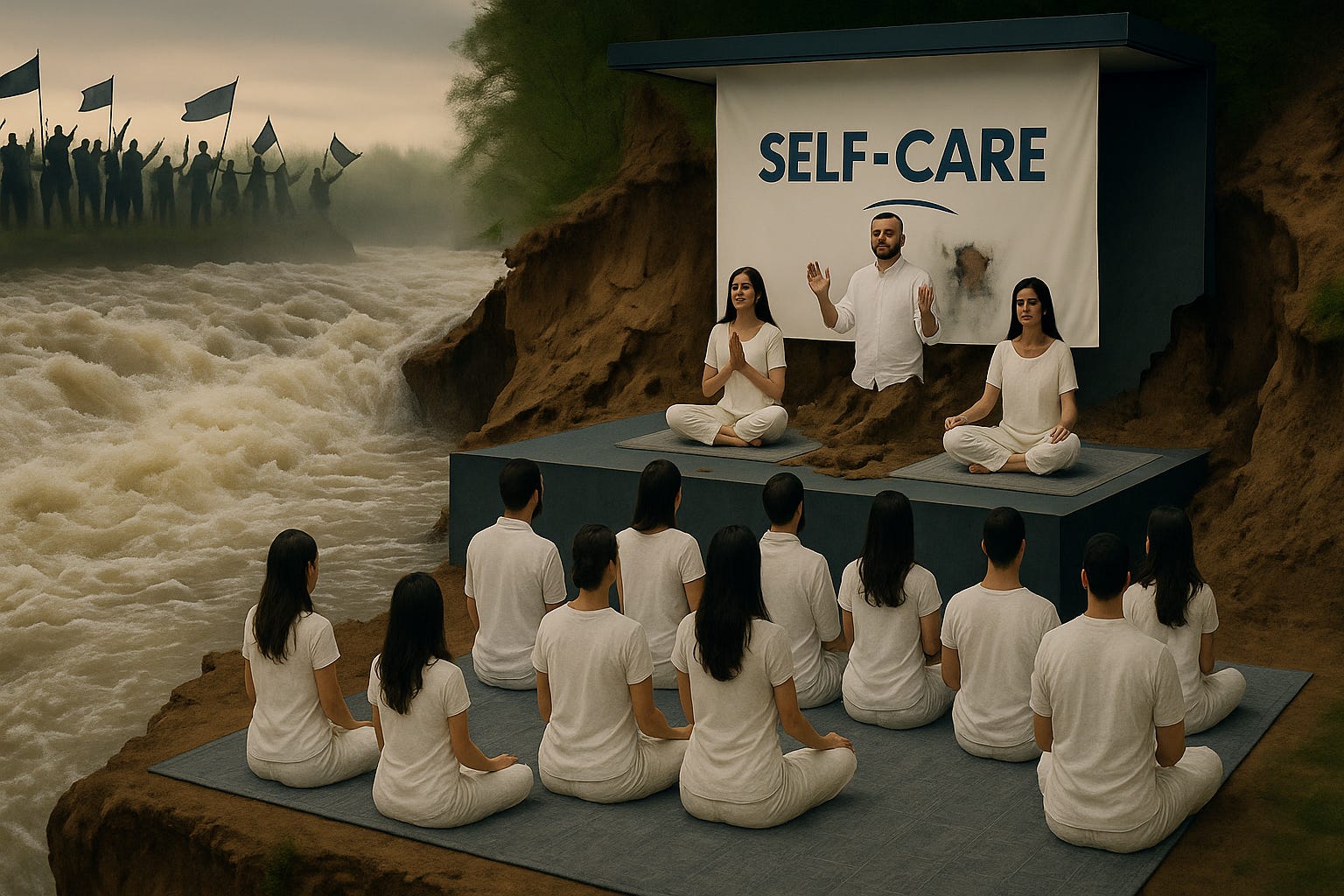
This case study examines a revealing exchange between Immanuel and a popular spiritual teacher that exposes the performative nature of much contemporary spiritual teaching. When asked how her profound vision quest insights about “standing up” to help others translated into support for Palestine, her response revealed a pattern of deflection, reframing, and spiritual bypassing that prioritizes brand protection over moral courage.
Through detailed analysis of this Instagram exchange, the article illuminates how the agents of the “Consciousness Industrial Complex” use the language of “self-care,” “private service,” and “spiritual discernment” to avoid taking public stances on urgent moral issues.
This examination serves as a critical resource for spiritual seekers learning to distinguish between authentic wisdom that integrates inner transformation with outer action, and performative spirituality that stops at comfort’s edge.
Introduction: A Perfect Storm of Spiritual Contradiction
In the landscape of modern spirituality, few moments crystallize the gap between wisdom and its application quite like the exchange I’m about to share.
What began as a simple question about applying spiritual insights to real-world suffering evolved into a masterclass in how agents of the “Consciousness Industrial Complex” protect themselves from accountability.
This isn’t just another story about spiritual bypassing. It’s a detailed examination of how even the most profound teachings can become shields against moral action when comfort is at stake. For those committed to decolonized spiritual practice, this exchange offers essential lessons about discerning authentic guidance from performative wisdom.
The point and purpose of this article is to educate seekers who will need more discernment than ever to find credible guides during these times; NOT to call out and shame/blame a specific teacher. In order to achieve this, I’ve changed the teacher’s name to “Ashley.”
About Ashley
Before diving into the full article, let’s set a baseline understanding of Ashley and her work. Ashley is a talented writer, singer, counselor, and elder caregiver devoted to helping people who are hurting, with over a decade of experience in spiritual and healing work. Inspired by her full self-recovery from almost 20 years of addiction, she utilizes her voice, experience, and wisdom to assist others through the healing process.
Ashley is the author of a book focused on trauma healing and spiritual development and also a companion resource for trauma healing work. She operates a spiritual teaching and healing platform that includes:
A 4-month course offering resources, language, and tools they need to address what has plagued them their whole life
Facilitated workshops described as an opportunity to open, learn, and heal from heartache and pain
Virtual live meetups with facilitators and community engagement
Individual counseling services
Ashley’s work focuses on supporting those who feel emotionally and spiritually wounded and have a desire to heal your life in an everlasting way and seek the support of a gentle guide to help you navigate your painful thoughts, feelings, and beliefs.
Ashley maintains an active presence on Instagram through both personal and professional accounts, where she shares spiritual content, personal stories, and promotes her healing work to her following.
Ashley’s Instagram Story: Beauty, Wisdom, and the Seeds of Contradiction
Ashley’s video post on Instagram begins with genuine vulnerability and insight. You can read the complete transcript at the end of this article, along with our complete comment thread exchange that led to the creation of this case study article.
Here’s a spiritual teacher sharing a transformative experience — a vision quest in the desert where she learned to stop crawling on your hands and knees, suffering and struggling and hurting because others are hurting. The core message? Stand up... You’re not helping the suffering of the world by suffering.
This is powerful medicine. Ashley describes viscerally feeling the world’s pain — the whales’ disrupted sonar, nuclear contamination in the oceans, the trauma of women around the world who’ve experienced violence. She shares how she used to believe that joining others in their suffering was a form of solidarity: I didn’t want to abandon those who were suffering. If there was a war, I wanted to feel what those victims were experiencing.
The breakthrough moment in her ceremony is genuinely moving. Spirit tells her: The stronger you are, the more powerful you are… the more resourced you are to help. This is wisdom many of us need to hear, especially those prone to empathic overwhelm or self-destructive patterns of taking on others’ pain.
The Test: A Simple Question, A Revealing Response
My initial comment was straightforward: How did these insights help you in showing support for Palestine over the last 2 years?
This wasn’t intended as a “gotcha” question, though it certainly baited a rather predictable response. I was genuinely curious how someone who’d learned to “stand up” and be strong enough to help others had applied this wisdom to one of the most visible moral crises of our time. Palestine has become what I described as a litmus test that many see as revealing whether someone’s compassion is genuine or performative.
Ashley’s response immediately revealed the first layer of deflection. Instead of addressing Palestine specifically, she pivoted to universal suffering: … inflicted suffering is happening everywhere, to humans all across the globe — killings, rapes, profound injustice. Far beyond humans, to trees, where entire forests are being wiped out.
Pattern Analysis: The Architecture of Spiritual Deflection
1. The Universalizing Deflection
When asked about a specific moral crisis, Ashley expanded to suffering everywhere. While technically true, this move serves to dilute focus and avoid taking a stance on a particular issue that might alienate followers or sponsors. It’s the spiritual equivalent of responding to “Black Lives Matter” with “All Lives Matter” — technically true but functionally evasive, deflecting from the specific issue at hand.
2. The Private vs. Public False Binary
Ashley positioned social media advocacy as somehow less authentic than private work: … the many traumatized and suffering victims, animals, youth, and elders I support on a daily basis is not reflected through what I post.
This creates a convenient escape hatch. By framing public advocacy as an illusionary space of change, where posting can relieve an internal feeling of helplessness, she simultaneously justifies her silence while implying that those who speak publicly are merely performing rather than helping.
3. The Reframe & Diminishment
Perhaps most revealing was how Ashley reframed my questions. She wrote: I sense the presence of pain and frustration in your words, as well as the potential of a desire to debate — which I consciously and discerningly will not embark on with you.
Notice the move here. My specific questions about her advocacy become evidence of my “pain and frustration.” My request for clarity becomes a “desire to debate.” This allows her to position herself as the spiritually mature one who won’t engage with someone coming from a lower vibrational state.
She continues: I also hear your request for proof that I am someone who can be trusted. But I never asked for proof of trustworthiness — I asked for specifics about how she’d applied her wisdom to Palestine. The reframe allows her to dismiss the question as somehow beneath her: While I don’t have a need to be approved of by anyone, ...
4. The Patronizing Praise
There’s another layer to Ashley’s deflection strategy that deserves examination: the tactical deployment of warmth as a weapon of diminishment. She opens with: Thank you for using your voice and thank you for your passion and care. On the surface, this appears gracious. Look deeper, and you’ll see how it functions.
By framing my substantive questions about Palestine as merely “using your voice” (as if I’m a child learning to speak up for the first time), and reducing my request for moral clarity to “passion and care” (implying emotion over reason), she positions herself as the benevolent teacher acknowledging a student’s effort while sidestepping the actual content of what I’ve said.
This patronizing move is reinforced by her liberal use of “friend” throughout her responses. The repeated friend creates a false intimacy that masks the power dynamic she’s establishing. She’s the wise teacher exercising discernment while I’m the passionate but perhaps misguided student who needs to learn emotional regulation. “Hi friend,” she begins, immediately establishing a tone that seems warm but actually serves to neutralize any serious engagement with the questions posed.
The disingenuousness becomes clear when you realize this appreciation for my voice comes wrapped in a dismissal of everything that voice is saying. It’s like patting someone on the head while showing them the door — a performance of kindness that functions as rejection.
The Irony: When Your Own Medicine Becomes Your Excuse
The profound irony is that Ashley’s vision quest story contains the exact wisdom she’s failing to apply. She learned that “standing up” and being strong allows you to help more effectively than crawling in the dirt with those who suffer. Yet when faced with an opportunity to stand up for Palestine — to use her platform, her voice, her strength — she chose the spiritual equivalent of remaining on the ground.
Her justification? I very intentionally invest my energy in hands-on support of those who I can actively help. But this creates another false binary. Many of us supporting Palestine publicly are also doing direct service work. The two aren’t mutually exclusive — unless maintaining your brand requires avoiding controversial positions.
The Tell: When Self-Care Becomes Self-Protection
Ashley’s final response is perhaps most revealing: I know and trust myself very well and I know the authenticity of where my energy is focused. This self-assurance in the face of moral crisis exemplifies how “self-care” and “boundaries” can become shields against accountability.
She concludes: I appreciate your engagement in this conversation and I will conclude my participation here.
The conversation is shut down, the questions remain unanswered, and the comfortable distance from controversy is maintained… a classic characteristic of privileged fragility.
What This Reveals About the Consciousness Industrial Complex
This exchange perfectly illustrates several key features of commodified spirituality:
1. The Aesthetics of Wisdom
Ashley’s video features professional lighting, careful but understated staging, and the studied presentation of a professional performer (which she is) — all signs of spirituality as branded content. The wisdom must be packaged beautifully and tastefully, but never challenge too deeply.
2. The Comfort Contract
There’s an unspoken agreement in spaces like these: teachers provide feel-good wisdom, followers provide uncritical appreciation (which they predictably did to the tune of around 80 comments, sans mine). When I broke this contract by asking substantive questions, the response was to reframe me as the problem rather than engage with the questions.
3. The Transformation That Doesn’t Transform
Ashley can share a powerful story about learning to stand up, but when standing up might risk followers, sponsorships, or brand alignment, suddenly the wisdom finds its limits.
Lessons for Decolonized Spiritual Seekers
For those navigating spiritual spaces while maintaining commitment to justice, this exchange offers crucial insights:
1. Watch for the Deflection Patterns
When teachers pivot from specific moral questions to universal truths, it’s often a sign they’re avoiding accountability. True wisdom can address both the universal and the particular.
2. Question the Private/Public Binary
Be wary of teachers who claim their real work happens invisibly while maintaining highly curated public personas. Authentic practice integrates private and public action.
3. Notice Who Gets Reframed
When asking substantive questions gets you labeled as “frustrated,” “debating,” “seeking approval,” or other weaponized thought-terminating cliches, you’re likely dealing with someone protecting their comfort (or spiritual delusion) rather than engaging authentically.
4. Test the Teaching
The real test of spiritual wisdom isn’t the beauty of the initial insight but how it’s applied when application requires courage. Does the teacher’s “standing up” extend to moments that might cost them something?
The Deeper Pattern: Anticipating Only Adoration
Looking at the original post’s comments, it becomes clear that Ashley expected and was prepared for only one type of response: gratitude and admiration for her wisdom. The framing — “Love you, friends” — sets up an echo chamber where challenging questions appear as violations of the love-and-light social contract.
This is the culture Creating Shifts identifies as needing disruption.
When spiritual spaces become places where only affirmation is welcome, they cease to be transformative and become merely comfortable.
Moving Forward: What Decolonized Practice Looks Like
Authentic spiritual practice doesn’t create separation between inner wisdom and outer action. It recognizes that genuine self-care sometimes requires discomfort — the discomfort of speaking truth, taking stands, risking the loss of followers who prefer their spirituality without justice.
The plant medicine insight about standing up rather than crawling is beautiful and necessary. But it’s incomplete if that standing up stops at the edge of our comfort zone. True spiritual strength means standing for justice even when it threatens our carefully curated brands.
Questions for Reflection
As you navigate your own spiritual journey, consider:
How do you distinguish between teachers who embody their wisdom and those who merely perform it?
When have you seen “self-care” used as justification for avoiding moral action?
What would it look like for spiritual communities to welcome substantive questions rather than deflecting them?
How can we honor genuine wisdom while still demanding its full application?
Conclusion: The Invitation to Deeper Practice
This exchange isn’t shared to shame or attack but to illuminate. Ashley’s vision quest wisdom about learning to stand up contains real medicine. The question is whether we — teachers and students alike — are willing to stand up fully, even when it risks our comfort, our followings, our carefully maintained brands.
The younger generations are watching. They’re seeing who speaks and who remains silent, who stands up and who finds elaborate justifications for remaining seated. They’re choosing their teachers based not on the beauty of their Instagram posts but on the courage of their convictions.
For spiritual teachers reading this: your audience is evolving
They’re seeking guides who can hold both self-care and solidarity, both inner peace and outer action. They want to learn from those who’ve integrated their vision quest insights into real-world courage.
For seekers: trust your instincts when teachers deflect rather than engage
Look for guides who can acknowledge when they’ve fallen short rather than reframing your questions as spiritual immaturity. Seek those whose “standing up” extends beyond the meditation cushion and so called “private service” into the streets, the protests, the uncomfortable conversations.
The world needs spiritual practitioners who’ve learned not to become the suffering AND who use their strength to stand for those who suffer. That integration — not the comfortable wisdom that stops at controversy’s edge — is what our times demand.
That’s the shift we’re here to create. Together.
What patterns have you noticed in spiritual spaces during times of moral crisis? How do you navigate the tension between self-care and solidarity? Share your experiences and insights in the comments below.
INCLUSION: POST VIDEO TRANSCRIPT & COMMENT THREAD
From Suffering to Strength: A Vision Quest Story
Introduction: A Message of Hope
Hi friend, how are you? I’m making this video because I want to share a story with you. I want to share some inspiration and words of support around collective suffering, internal love, and happiness. I’ve thought of ways to articulate this message about the importance of not becoming the suffering when we witness it and staying tethered to love. I keep being brought back to the story of where I learned that—where I really got it.
I thought the best thing I could do to pass this inspiration along to you is to just tell you the story. So if you’re up for it, get comfortable—this is going to be story-hour.
The Vision Quest Begins
Many years ago, I was doing a vision quest, a plant medicine ceremony in the desert. For those of you who have done vision quests and shamanic ceremonies—going into an altered state, Carlos Castaneda style—it’s deep work. It’s big. And it has a way of stripping you down to the core of the truth.
I needed that because I had spent a long time not living in my truth: being an addict, being compulsive, being emotionally imbalanced and suffering. I was suffering for a very long time—physically, mentally, and emotionally.
Immersed in the World’s Pain
So I did this vision quest, and I was hurting. I was struggling. As the medicine started working with me, I found myself being immersed in different settings, different landscapes where there was suffering.
The Ocean’s Anguish
I was brought into the ocean, looking around and feeling what the whales are going through. Their sonar being disrupted by so much activity under the water, feeling what nuclear activity has done to the oceans and to the whales, the trash and the plastic. I just leaned in and felt it, and I felt nauseous.
To harmonize, to unite, to feel that much suffering—it was so daunting, and yet I didn’t want to look away. I didn’t want to be in denial. I didn’t want to avoid the truth. I wanted to courageously witness the truth. If someone else was suffering, I didn’t want to abandon them. I wanted to be with their suffering. So… I felt that…
Women’s Trauma in India
Then I moved, and I went over to India. I felt all of the women who had been raped and their bodies pillaged in a culture that has, from time to time—it’s not the whole culture—not offered the support and respect that women deserve. This was influenced because before doing this vision quest, I had just returned from India, where I was specifically there to help the One Billion Rising movement. It was really focused on the awareness of violence and abuse towards women.
Here I am feeling even more nauseous, just being with the reality of what women are experiencing—the suffering. Having experienced my own abuse and my mother’s journey and all of the grandmothers, just like the generations of this destruction towards women, I felt it. I felt nauseous, and I felt the suffering.
The Pattern of Joining Pain
I kept moving and swimming and crawling through this realm of suffering, feeling that I was doing what I needed to do to support. I was motivated by this desire to not abandon. I didn’t want to abandon those who were suffering. If there was a war, I wanted to feel what those victims were experiencing. If there was trauma to a species, I wanted to know and feel that with them so I don’t abandon them.
This is how I felt for a long time. Again, I was struggling. I was actively addicted, my body deteriorating, my life force being drained out of me, and I was living in suffering. So to me, at that time and for a long period before that, the way I could support those who were suffering and struggling was to join them and suffer alongside them.
The Breaking Point
Now, here I am in the desert doing this medicine ceremony, and I’m just getting nauseous because I’m just feeling the suffering of the planet and the world and the people and the animals, and I get sick. I’m out in the desert, my lips are burning, and I’m getting sick, and now I’m actually crawling.
My lips are getting burned at this point, so they’re actually bleeding. The desert is dry and sharp, so I am actually bleeding. My hands are bleeding, my lips are bleeding. I’ve been throwing up because of the medicines, and now I’m just a mess—crawling around, crying, sobbing, guttural crying and sobbing.
Somehow I felt that maybe I was releasing it, maybe I was helping it. Maybe I was doing something to help. I really believed this up until that point—I believed I was helping. To just be suffering… somehow, I was helping the suffering.
The Moment of Clarity
And I had a realization—a very clear realization. There was self-reflection in that moment, looking at myself crawling, bleeding. The addiction I dealt with was [REDACTED], so of course I had been [REDACTED], and I had a lot to look at around [REDACTED].
I thought, “How is this helping?” I care—that’s true. I deeply care. I do not want to abandon—that is true. I want to help—that is true. But I’m killing myself. I am crawling around bleeding. I am actively dying because I witnessed the dying. I witnessed the pain, the suffering, and I am doing what I can to help by harmonizing with them.
The Voice of Wisdom
Then spirit—that voice of wisdom and higher self and spiritual guidance—came through in that moment. It said:
“Stand up. Stand up. You crawling on your hands and knees, suffering and struggling and hurting because others are hurting is not helping their hurt. You’re not helping the suffering of the world by suffering.
Stand up. Take care of yourself, take care of your body. Nurture yourself, nourish yourself. Let your spine be strong and tall, let your arms be strong, and then you can help. When you take care of yourself, when you stand strong, when you care for yourself, when you allow yourself to witness the suffering but not become it—to hold the suffering with one hand but take care of yourself with the other—you rise up, and you have the ability to lift others.
The stronger you are, the more powerful you are, embodied, the healthier you are, the more resourced you are to help—to do something to help.”
A New Understanding of Care
I care again—that is the truth. I care. But my caring is now coming through a lens of discernment and consciousness and action. The amount of people I could help when I was suffering compared to the amount of people I can help when I’m healthy, strong, and thriving is very different.
Because I am human, I am vulnerable. I have this one body, this opportunity, and if I don’t take care of it and get proper sleep and eat well, and regulate myself and ground down and stretch, and do all the things that nurture that life force energy—if I’m just depleted and allowing myself to be depleted, I’m not actually helping.
I want to help. I want to do absolutely everything I can to help as many people and animals as I can while I’m alive. And that’s why I have to take care of myself.
A Message for You
I know you care as well. If you’re suffering because you think that’s going to help those who are suffering, I want you to consider standing up. Getting rest when you need it. Eating healthy food, talking to someone when you have heavy tears in your heart. Prioritizing self-care so that you can be stronger and care for those who need it.
Because we need you. We need you strong and healthy. You’re going to help a lot, and it’s going to be good. It’s going to be important. You’re going to harmonize with love instead of pain, and you’re going to amplify that and bring that to the world. That’s what we need.
Closing Thoughts
I know this was a little lengthy. I just didn’t know how to share this with you without telling you the truth of where I learned it. My prayer is that we all start to learn it, and we bring a force of love and healing to this world.
Okay, love you, friend. Thank you.
COMMENT THREAD
IMMANUEL’S FIRST COMMENT:
How did these insights help you in showing support for Palestine over the last 2 years?
ASHLEY’S RESPONSE:
Hi friend. By choosing to save my own life, I’m here right now and that offers me the ability to be alive and be part of the solution. To witness the truth of what’s happening in Palestine, to not turn away from it, to stay close, to educate myself, to speak about it in conversation. And, inflicted suffering is happening everywhere, to humans all across the globe—killings, rapes, profound injustice. Far beyond humans, to trees, where entire forests are being wiped out. To animals, where entire species are being decimated. And I am stepping forward to take action. Personally, through literature and documentary film making. Externally, through not shaming others or scolding them, or traumatizing them more deeply with fear, but through lifting them up. Through helping people heal through their silence and shame in order to build confidence, find their voice and activate their power. I believe love is more powerful than fear, and each human has a super power skill that often lies dormant. When we heal internally, we unlock our power and have the confidence to step forward and bring our special gifts to the collective solution. I see you and the passion you feel for change. Thank you.
IMMANUEL’S RESPONSE:
Thank you for your response. I appreciate you engaging with my question, and I hope you’ll understand that I’m asking for more specifics because accountability matters deeply to me when choosing or recommending spiritual guides.
You mentioned witnessing the truth in Palestine and speaking about it in conversations. I’m curious about the substance of those conversations…
What conclusions did you reach, and how did you frame the situation to others?
Given how many people have faced real consequences (lost relationships, professional opportunities) for speaking out, I imagine these weren’t easy discussions for you to have.
More importantly: did you make Palestine a visible part of your public platform? This is something I and many others look for when evaluating the credibility of spiritual teachers during this time. If you did speak publicly, could you point me toward where I can see that advocacy?
I do understand that suffering exists everywhere (most supporters of Palestine are also actively supporting action in many other areas, as well), but Palestine has become something more specific—a litmus test that many see as revealing whether someone’s compassion is genuine or performative regardless of how many times they speak in general terms about suffering and love. The “suffering is universal” response, while true, often feels like deflection from this particular moment of moral clarity.
You mentioned taking action through literature and documentary work, and helping people “heal through their silence.” Can you be more specific about what this looks like in practice? What concrete steps are you taking, and how do they connect to Palestine specifically?
I’m not here to shame or attack you or anyone—I’m genuinely trying to understand whether your approach represents the kind of leadership I and many others can trust during this critical time. The spiritual community’s response to Gaza has been revelatory, and many of us are being very intentional about who we choose to learn from going forward.
I’d welcome a response that goes deeper into the specifics of your advocacy and action, rather than speaking in generalities about love and healing.
Thank you.
IMMANUEL’S FOLLOW UP COMMENT ON PREVIOUS COMMENT:
In terms of the guidance you offer in your touching and heartfelt story, the message is solid… AND there are many who are actively speaking out about Gaza who are also well versed in trauma-awareness and self-care practices.
Your vision quest story about learning not to become the suffering is valuable wisdom—but it raises a crucial question about how we apply this insight during moments of profound moral clarity like Gaza.
If spiritual teachers and influencers chose silence (and I’m not saying you did until you’re able to respond in more depth to my questions above) about genocide because of “self-care” or fear of consequences, why would anyone seeking genuine healing want to work with them?
Wouldn’t people looking to transform trauma related to Gaza and the world naturally gravitate toward guides who actually faced the darkness when it mattered most?
I also have had meaningful medicine journeys. During one session (the third night out of three consecutive Ayahuasca journeys with Don Jose Campos) where I remained sitting upright as long as possible while being internally bombarded by relentless volleys of what felt like psychic attacks, I was told: “There is no shame in laying down... but a time will come when we will need those who stand up.”
You use the phrase “stand up” frequently in your story.
I agree with that call—but we need honesty and forthrightness from those who have considered themselves “helpful in times of crisis” for decades. Many of whom I directly supported to reach large audiences over the years of working to launch media, authors, and classes at [REDACTED FOR AUTHOR PRIVACY AND LEGAL PROTECTION VIS-A-VIS SIGNED NDAs], and many others.
Perhaps it’s time for status quo, de facto spiritual teachers (and their students) to ask themselves: “Are we truly the teachers the world needs right now?”
The answer, for many, may honestly be “no.”
The world is looking for guides who can demonstrate that self-care and moral courage aren’t mutually exclusive—who can show us how to witness suffering without becoming it while still taking the risks that love demands of us in critical moments.
That’s the kind of “standing up” that transforms both ourselves and the world.
ASHLEY’S RESPONSE:
Thank you for using your voice and thank you for your passion and care. I am mindful in what I speak with you right now as I sense the presence of pain and frustration in your words, as well as the potential of a desire to debate—which I consciously and discerningly will not embark on with you.
I also hear your request for proof that I am someone who can be trusted, whose compassion is authentic, who is taking action towards change. While I don’t have a need to be approved of by anyone, for you to genuinely and truly understand the work that I do, or where my actions take place, or whether I am genuinely and actively compassionate or not, would require getting off of social media. To understand the many traumatized and suffering victims, animals, youth, and elders I support on a daily basis is not reflected through what I post.
I hear your sincere emphasis on social media being the center point of change; the determining factor and litmus test of someone’s credibility; the location where injustice is transformed. Seemingly, those who post about Palestine are on one side: trustworthy, authentic, and actively compassionate. Those who are not posting are on the other: inactive, inauthentic, and untrustworthy.
I feel differently.
While social media can be supportive in spreading awareness, it can also be an illusionary space of change, where posting can relieve an internal feeling of helplessness, supplying someone with a temporary feeling that they are taking action to help a situation.
I often witness social media posting lacking the hands-on support needed in the World. I believe that the actual action needed is much closer and more hands-on.
I very intentionally invest my energy in hands-on support of those who I can actively help. Victims of rape, beings who have been tortured and abused, innocent children who have been traumatized. And, I don’t need to write it out, or prove myself. I know and trust myself very well and I know the authenticity of where my energy is focused.
Again, I appreciate your engagement in this conversation and I will conclude my participation here.
Thank you.
IMMANUEL’S FINAL RESPONSE:
Thank you for responding. I do appreciate you taking the time to engage, and I will make my final statement and let this thread lie.
I want to clarify—I wasn’t looking for a debate, just a clear response to my questions, which I believe I now have. Your answer is quite “on brand” and aligns with what I expected based on the patterns I’ve observed in “spiritual spaces” during this time. Mine isn’t the voice of someone who is currently in pain or frustrated… that’s just an attempt to reframe this where I’m the one not seeing the bigger picture (which I mostly certainly do).
You know, Ashley, for a long time I honestly thought you and Kevin [her partner, also not real name and also silent on Palestine, who has his own “wisdom” platform teaching astrology and offering spiritual counseling online] were among the authentic voices in this space. I bought into the carefully curated vibe. I thought that about many of the teachers I’ve interacted with or otherwise helped reach large audiences over the years.
Your response demonstrates exactly what many of us have been witnessing: the tendency to reframe direct questions about Palestine as requests for proof when they’re actually invitations for moral clarity and alignment. The framing that social media activism is somehow less authentic than private work creates a false binary. Many of us are doing both—supporting people directly while recognizing that silence on genocide, particularly from those with platforms, sends its own message about priorities.
The suggestion that speaking about Palestine is merely about “relieving internal helplessness” rather than responding to a moral imperative reveals a fundamental misunderstanding of this moment. For many spiritual practitioners, remaining silent while children are systematically killed represents a profound misalignment between inner values and outer expression—exactly the kind of spiritual bypassing that prioritizes comfort over conscience.
Your vision quest story about learning to “stand up” contains real wisdom. The younger generations have been watching to see whether that standing up includes the kinds of moments that require risking comfort for what’s right. They’ve observed how many established teachers have crafted elaborate justifications (like yours here) for why they couldn’t stand for justice when it mattered most.
If you honestly want to reclaim credibility as a wisdom carrier, I invite you to read Creating Shifts (available FREE online). If you can look in that mirror and examine what “self-care” really codes for when it becomes a shield against moral action, maybe you’ll discover the integration your teachings are missing.
I have my answer about where you stand. Thank you for the clarity.
Endnotes
The term “spiritual bypassing” was coined by psychologist John Welwood in 1984 to describe the tendency to use spiritual ideas and practices to sidestep or avoid facing unresolved emotional issues, psychological wounds, and unfinished developmental tasks.
The “Consciousness Industrial Complex” references the commodification of spiritual teachings within late capitalism, similar to how Theodor Adorno and Max Horkheimer analyzed the “culture industry” in Dialectic of Enlightenment (1944).
The Palestine solidarity movement has indeed become a defining moral issue for many younger spiritual practitioners, particularly following the escalation of violence in Gaza beginning October 2023.
The pattern of “universalizing deflection” mirrors what Robin DiAngelo identified as defensive moves in White Fragility (2018), where specific instances of injustice are deflected through appeals to universal suffering.
Vision quests and plant medicine ceremonies have complex histories rooted in Indigenous traditions that have been increasingly appropriated and commodified within New Age spiritual markets.
Further Reading
These resources provide historical and theoretical context for understanding how spiritual teachings can become divorced from ethical action, and offer alternative models for integrating inner work with social justice.
On Spiritual Bypassing and Performative Spirituality:
Welwood, John. Toward a Psychology of Awakening: Buddhism, Psychotherapy, and the Path of Personal and Spiritual Transformation. Shambhala, 2002.
Masters, Robert Augustus. Spiritual Bypassing: When Spirituality Disconnects Us from What Really Matters. North Atlantic Books, 2010.
Lasch, Christopher. The Culture of Narcissism: American Life in an Age of Diminishing Expectations. Norton, 1979.
On the Commodification of Spirituality:
Carrette, Jeremy and Richard King. Selling Spirituality: The Silent Takeover of Religion. Routledge, 2004.
Roof, Wade Clark. Spiritual Marketplace: Baby Boomers and the Remaking of American Religion. Princeton University Press, 1999.
Lau, Kimberly J. New Age Capitalism: Making Money East of Eden. University of Pennsylvania Press, 2000.
On Decolonizing Spiritual Practice:
Menakem, Resmaa. My Grandmother’s Hands: Racialized Trauma and the Pathway to Mending Our Hearts and Bodies. Central Recovery Press, 2017.
Tuck, Eve and K. Wayne Yang. “Decolonization is not a metaphor.” Decolonization: Indigeneity, Education & Society 1.1 (2012): 1-40.
Smith, Linda Tuhiwai. Decolonizing Methodologies: Research and Indigenous Peoples. Zed Books, 2012.
On Moral Action and Spiritual Practice:
Loy, David R. A Buddhist History of the West: Studies in Lack. SUNY Press, 2002.
King, Sallie B. Socially Engaged Buddhism. University of Hawaii Press, 2009.
Thurman, Howard. Jesus and the Disinherited. Beacon Press, 1949.
On Cultural Appropriation in Spiritual Spaces:
Aldred, Lisa. “Plastic Shamans and Astroturf Sun Dances: New Age Commercialization of Native American Spirituality.” American Indian Quarterly 24.3 (2000): 329-352.
Deloria, Philip J. Playing Indian. Yale University Press, 1998.
Critical Perspectives on Self-Care Culture:
Gill, Rosalind and Shani Orgad. “The Confidence Cult(ure).” Australian Feminist Studies 30.86 (2015): 324-344.
Ward, Jesmyn, ed. The Fire This Time: A New Generation Speaks about Race. Scribner, 2016.
hooks, bell. All About Love: New Visions. William Morrow, 2000.
Statement on AI Use: This work is created with the assistance of current large language model AI systems. While these technologies exist within problematic extraction—trained on collective knowledge without consent, demanding massive computational resources, relying on exploitative labor—they also exist as tools that can be directed toward different ends than corporate profit and power consolidation. As an independent publisher without institutional resources, I use these systems to amplify and accelerate analysis emerging from decades of practice and study. The AI doesn’t generate the ideas, frameworks, or vision here—those come from human struggle, lived experience, and sustained inquiry into collective liberation. It serves as collaborative thinking partner and research assistant, making possible a scale and speed of work otherwise inaccessible given material constraints. This use is undertaken with full awareness of its contradictions and costs, and with commitment to transparency and directing these tools toward transformation rather than further enclosure. For detailed discussion of these ethics and tensions, see the full AI statement on the About page.