
The Builders Are Already Here
In “The Last -isms,” we explored what won’t work. Here we aim higher — to imagine what could work, and who’s doing it.

“Defeat is a state of mind; no one is ever defeated until defeat has been accepted as a reality.”
— Bruce Lee
This is the longest day… the moment the light, having reached the limit of its expression in this cycle, begins its surrender.
The Sun crosses into Cancer today — the sign of home, roots, the ancestral line, the emotional foundation, the slow cyclical rhythms that the extractive era was built to override. Jupiter has spent this entire year exalted in Cancer, the most generous placement the planet holds, abundance pouring into the house of nourishment and belonging. On June 30, nine days from now, Jupiter leaves Cancer for Leo.
The most fertile transit of the last twelve months in the sign of home is closing.
Even read symbolically, the sky this month is saying something legible. For the past year and a half the slow background pattern has been a long turning-away from one habit of mind — the measuring, sorting, mechanizing instinct that treats the living world as a system to be optimized — toward an older recognition that we are inside a single living whole rather than standing outside it with instruments.
That turn finishes its current phase within weeks. And the heaviest pairing in the sky right now sets discipline against vision at the exact point where the cycle starts over: the old instruction to take the dream and give it form.
The window is closing. What was planted has either taken root or it hasn’t.
Where We Left Off
“The Last -isms” worked the four major contenders — capitalism, socialism, communism, transhumanism — down to the thing they share, which is not politics but an operating system: the conviction that the world is a machine and the only real question is who drives it.
Different drivers, same vehicle, same cliff.
The piece ended on a gesture toward a different vehicle entirely, the Creative Age, which runs on different metaphysics and will be cultivated by people who have not finished arriving.
Diagnosis is easier than vision. Vision is easier than concrete description. This article tries the third, because vision without specificity is a form of bypass — the lush imagined future doing the same work that “love and light” does in a wellness studio, soothing the listener while changing nothing.
The Creative Age has to be described in working parts that exist now… attached to people whose names you can look up now.
There is an obstacle in the way of reading any such description fairly in 2026, and it has to be named before the description can land. The obstacle is the manufactured conviction that the controllers have already won — that the consolidation is total, the outcome settled, resistance a kind of nostalgia.
This is where Bruce Lee’s line most resonates: Defeat is a state of mind
The system’s apparent victory is contingent, and what it is contingent on is our acceptance of the story that it has won. The two halves of the case run together. Externally, the order is thermodynamically unstable, paying more every quarter to maintain a grip the structure of reality keeps loosening. Internally, the consent that the grip depends on is ours, and consent is refusable.
The act of describing the alternative is itself a withdrawal of consent — not because naming a thing conjures it, but because the manufactured despair is sustained, in part, by the absence of any clearly described alternative to stand next to the catastrophe. A doom prophecy and a counter-prophecy both run self-fulfilling; the difference is which one gets built.
Naming the working parts is one way the counter-narrative gets made.
Today, Father’s Day in the U.S., is also my son’s fifteenth birthday, so there’s just a lot up for me during this particular moment. He belongs to the “Artist” generation (as named by the Fourth Turning generational framework), the cohort being shaped by this crisis during the years that set the terms for everything after — the ones for whom the Creative Age is being built.
Different Metaphysics, Not a Fifth -ism
The Cartesian-industrial frame says the world is a machine and the argument is over ownership. The Creative Age frame says the world is alive, and that humans are participants inside a living system rather than its owners or its engineers.
It is not a slogan but a description of operating cosmologies that have been running successfully on every continent where colonization has not yet finished stamping them out: Mitákuye Oyás’iŋ, the Lakota knowing that a person is related to all of creation and that you do not poison your relatives; ayni, the Quechua practice of sacred reciprocity in which everything received requires something given back; whakapapa and kaitiakitanga, the Māori genealogy that threads humans into the same lineage as the land and the guardianship obligation that follows from it; the Aboriginal Australian relationship to Country, a continent’s worth of cultures treating the land as a conscious being with yesterday, today, and tomorrow.
This is living technology for planetary relationship that has been operating, by the most conservative reckoning, for tens of thousands of years.
What changes when the world is a living system rather than a machine is everything downstream of the word value. Value stops meaning extractable surplus and starts including soil health, the trust held between generations, the bandwidth a watershed has left to recover, the hours a child spends within reach of a grandparent. The ledger gets longer because the accounting finally includes the things the old ledger had to externalize in order to function.
Work stops being a category you can cleanly separate from play, learning, and service; a person might spend a morning in ecological restoration, an afternoon mediating a neighborhood conflict, an evening teaching dance, and have all three counted as contribution rather than ranked against each other. Wealth stops being individual accumulation and gets measured at the scale of the community, the watershed, the lineage — at which point the gift economy and the commons stop being charming exceptions and become the structural default.
The operating cosmology is ancient. What is new is the technological capacity to run it at scale — sovereign and auditable AI, distributed energy, biomimetic design, distributed governance — capacity the extractive era developed and is constitutionally unable to use rightly, because the machine cannot operate the instruments of a living world without first ceasing to be the machine. The Creative Age is the meeting place between the oldest cosmology and the newest tools.
Who Is Actually Building This
The description fails if it stays abstract, so here are some of the builders of the Creative Age, starting with the Indigenous architects of the planetary cosmology, because the work is theirs first.
Lyla June Johnston’s doctoral research at the University of Alaska Fairbanks documents pre-colonial Indigenous societies functioning as keystone species — ecological engineers whose long-term forest management, including the centuries-deep Indigenous chestnut systems of eastern North America, increased biodiversity rather than diminishing it, which dismantles the founding colonial fiction of an untouched wilderness that needed European management. Indigenous-managed lands hold a disproportionate share of the world’s remaining intact, high-biodiversity areas.
Robin Wall Kimmerer has given the non-Indigenous reader the Honorable Harvest and the grammar of animacy, a way of speaking that returns aliveness to the world the language had reduced to objects.
Tyson Yunkaporta works the territory of pattern thinking; Leanne Betasamosake Simpson the practice of Indigenous resurgence. And the cosmological claim is being made operationally, parcel by parcel: the Esselen Tribe’s 2020 return to ancestral lands in Big Sur, the Wiyot Tribe’s recovery of Tuluwat Island in Humboldt Bay, the long fights for Mauna Kea and the Black Hills.
Land Back is not a metaphor; it is kinship with the land made legally binding.
The Black radical tradition is extending into constructive politics, past critique into worldbuilding. Olúfẹ́mi O. Táíwò’s Reconsidering Reparations reframes reparations not as inward redress alone but as constructive worldmaking — the just distribution of the costs of moving us from this unjust world to the just one — and his directive is the cleanest instruction in the literature for what the Creative Age asks of a person: act like an ancestor, do what you can to shape the world your moral descendants will inherit, and trust them to carry it on.
Adom Getachew supplies the theoretical scaffold of worldmaking; William Darity and Kirsten Mullen’s From Here to Equality supplies the implementable bridge-period program, the actual arithmetic of a federal reparations plan. The deeper claim and the urgent one do not compete. Reparations now, the new world also; the “also” is not a deferral but the structural commitment the urgent claim was always pointing toward.
Healthcare is being rebuilt as a commons. The Medicare-for-All organizers are fighting the visible bridge fight, but the larger architecture is healthcare understood not as a commodity but as the communal responsibility a people takes for one another’s flourishing — organized around prevention, food, soil, air, water, mental and spiritual wellbeing, and relationship to land, and already partially built in mutual aid networks, in community clinics, and in the integration of traditional and allopathic medicine inside some sovereign Indigenous nations.
Justice is being rebuilt the same way. Howard Zehr’s foundational restorative-justice work, Indigenous peacemaking circles operating inside tribal courts, and school-based restorative practices replacing zero-tolerance discipline across hundreds of districts are the institutions that make prisons unnecessary rather than the institutions that merely replace them — abolition as construction, not subtraction.
The food system is being rebuilt from the soil up. Allan Savory’s holistic management, the Land Institute’s decades of perennial-grain breeding that produced Kernza, permaculture and biodynamic agriculture, and the explosion of CSA networks, community gardens, and urban farms are, collectively, the work of putting back the topsoil the extractive century spent stripping.
The technology layer is being rebuilt as a commons too: community-owned platforms, the platform-cooperativism movement organizing the people who run them, open-source frameworks, the whole post-extractive computing argument that stands as the alternative to the upload-and-escape transhumanism the last article took apart.
And the relocalization is everywhere, once you can see it: community land trusts, time banks, tool libraries, repair cafés, Buy Nothing groups, local currencies, participatory budgeting in the long Porto Alegre lineage, the citizen assemblies that drafted real constitutional change in Ireland, the Tenderheart Community model (by Amber B. Pagaling) featured in the Creating Shifts book.
Dr. Butch Ware’s spiritual and political work as bridge-work, holding the difference between organizing people and merely mobilizing them; the California Reparations Task Force turning Táíwò’s argument into statute; Chumash and Esselen partnerships doing the climate work at the parcel and bioregional scale.
What ties all these domains together is a single move repeated in different materials: each one takes something the extractive era had priced and privatized — health, justice, food, attention, the land itself — and returns it to the web of mutual obligation it was severed from. The vehicle is different because the relationship to the world is different, all the way down.
These are not future projects. They are running. The dying era is loud; the building era is, by necessity, distributed and often unseen.
What It Looks Like
Picture an ordinary day in a neighborhood where some of this has been built, not as a glossy montage of food forests and sunlit domes but as social architecture.
A woman goes to the community clinic and the visit costs her nothing at the point of care, because the cost is carried by the community rather than billed to the patient, and because the clinic’s idea of medicine already includes the food she eats and the soil tests of the watershed she drinks from. When she leaves, the prescription is as likely to be a plot in the community garden and a standing appointment with a neighbor as it is a pharmaceutical.
A teenager spends part of the week apprenticed to a carpenter, a permaculture designer, an elder — learning inside relationship and real work rather than inside the age-segregated batch processing we still call school, and the adults teaching him are counted, and supported, for the teaching.
Two neighbors in conflict take it to a peacemaking circle instead of to court, where the harm is named in the room, the repair is designed by the people it touches, and the accountability is structural rather than punitive; nobody is exiled, and nobody is left unaccountable.
The energy for the block is generated locally, with the surplus metered back into the grid as a contribution rather than sold off by a distant utility.
Most of the calories come from inside fifty miles, which means the people who grow the food and the people who eat it are inside the same web of obligation.
The household’s AI assistant runs on a community-owned model that does not sell the family’s data and can be audited by anyone who asks to see how it works.
The cultural life of the place — the storytelling, the music, the ceremony — is open-source, locally made, taught across generations, and free at the point of consumption, which is to say it has been returned to the commons the entertainment industry enclosed.
Every one of those arrangements is being built right now, in working parts, by people who stopped waiting for permission. A futuristic aesthetic is not the point and never was. The social architecture is — the load paths, the way the weight of one person’s flourishing is held by the structure around her rather than dropped entirely on her own shoulders.
Culture Precedes Policy
The Civil Rights Act of 1964 and the Voting Rights Act of 1965 did not arrive in a vacuum. They arrived in a country that had spent a generation listening to “Strange Fruit,” watching Jacob Lawrence’s Migration series, looking at the open-casket photographs from Emmett Till’s funeral that Mamie Till-Mobley insisted Jet publish, hearing the SNCC Freedom Singers in church basements, reading Baldwin and Hansberry. The legislation was the visible peak of cultural work that had been reorganizing the country’s imagination for twenty-five years before the law could recognize what the artists already knew.
The new vocabulary is being written, right now, by artists and mythologists and storytellers and builders, and it will reach legislation on the same delay it always has. In “To ‘Make’ Art or To Allow Art” I argued the mechanism underneath this: “proper art” works not by demanding a belief but by transforming perception, and transformed perception is the prerequisite for any change in how a person acts. The culture moves the seeing; the seeing moves the doing; the policy ratifies what the doing already made normal. That is the order of operations, and it has not changed.
“Proper art” is James Joyce’s term, spoken by Stephen Dedalus in A Portrait of the Artist as a Young Man, where Stephen builds an aesthetic theory on Aquinas. Stephen sorts art by the kind of feeling it excites. Improper art is kinetic — it moves you — and takes two forms: the pornographical, which excites desire and “urges us to possess, to go to something,” and the didactic, which excites loathing and “urges us to abandon, to go from something.” Propaganda is didactic art: it demands a belief and pushes you toward an act. Proper art, by contrast, is static. It produces what Stephen calls aesthetic arrest — “the mind is arrested and raised above desire and loathing,” held in contemplation rather than driven toward or away from anything. Its end is not persuasion but claritas: the radiance, the “whatness” of a thing apprehended fully as itself — the instant a thing stops being a means and becomes, luminously, what it is.
This can look like a contradiction of my claim: if proper art arrests action, how can it be the prerequisite for changed action? But the arrest is the mechanism, not the obstacle. Didactic art short-circuits perception — it tells you what to feel and where to march and leaves your way of seeing untouched, which is why its effects are loud and shallow and reversible. Proper art refuses the shortcut. By holding you still, above desire and loathing, it does the slower and more total work of reorganizing what you are able to see; and once the seeing has changed, the doing follows on its own, never having been commanded. The stasis is not passivity. It is where new perception is set. Hence the order of operations: the culture moves the seeing, the seeing moves the doing, the policy ratifies what the doing already made normal.
Beneath even the culture sits a deeper question: who forms the people who do the imaginative labor in the first place. Buckminster Fuller liked to point at the trim tab — the small lever set into a ship’s rudder by which one person, moving early and in the right place, can turn a mass thousands of times their size. In a civilization the trim tab is a formed human being, and the places that form such people on purpose, teaching them to read the world deeply and to build something with what they find, are doing the most upstream work there is. It is slow and unglamorous, and it almost never shows up in a given year’s news. It is also where the next vocabulary finds its first fluent speakers, which is why a turning like this one rewards anyone willing to put their energy into the forming of people rather than the winning of arguments.
Which obligates me to say where I actually stand in it. I am not Indigenous, not Black, not in the Hero generation doing the load-bearing crisis work, not in the Artist generation who will build what comes next. I’m Gen X, born in 1970, formed into adulthood through the 80s and 90s. The set of jobs available to me is narrower and specific: clear conceptual ground, name what is dying so the living can stop defending corpses, hand tools forward without strings, refuse to colonize the new vocabulary with the old terms.
This site, CreatingShifts.com, is one tool. The Creating Shifts book — free to download and read here — powers it. The Prof. Jiang and the Creative Age living book I opened to collaborators earlier this month is a tool. Volunteering for Dr. Butch Ware’s gubernatorial campaign was to become a tool in the name of shared values.
What This Requires, by Generational Station
For the Artist generation — the cohort being shaped by this polycrisis in the years that form a person — the task is to keep building, to keep refusing the false choice among the four dying -isms, and to speak the operating cosmology you are already native to in the languages and forms it actually wants to be spoken in. You were never waiting for permission; the rest of us are catching up to that.
For the Hero generation — the Millennials, born roughly 1982 through 2004 — the task is the load-bearing crisis-era work most of you are already doing at real personal cost: holding the line, raising children inside the unraveling, organizing and crewing the bridge structures the next phase will stand on.
For the middle generations — Generation Jones, Gen X, the Xennials on the cusp — the task is the hinge. You hold the institutional knowledge and the implementation capacity at once. Use the positions you occupy, while you occupy them, in service of the structures the next phase needs, rather than guarding them as your own.
For the elders, the task is testimony, ground-clearing, and tool-handing — the living memory, carried in the body, that civilizations can fall and be rebuilt.
Across every station the practice is the same, the cycle I call Receive, Realize, Render: take in the wisdom, metabolize it into understanding, express it in built form.
Jiang Xueqin, who has spent his career reading the rise and fall of civilizations, names what sits under the refusal to despair: “Fundamentally, we humans are extremely creative, extremely resilient. And the spark in us hasn’t activated yet. But in the circumstances that are required of us, we will become creative . . . what makes us who we are is our creativity, our resilience, our empathy, our imagination. This is who we are, really.”
Solstice in Cancer
Jupiter leaves Cancer in nine days. The most fertile transit of the year in the sign of home, roots, and the ancestral foundation is closing, which makes today a moment to ask what was planted, properly, in the twelve months the planet of abundance spent exalted there. Some of it is already growing, visibly, in the movements and the working parts this description has named. Some of it is invisible because it is still below the soil line, doing the slow root work that does not announce itself and cannot be hurried.
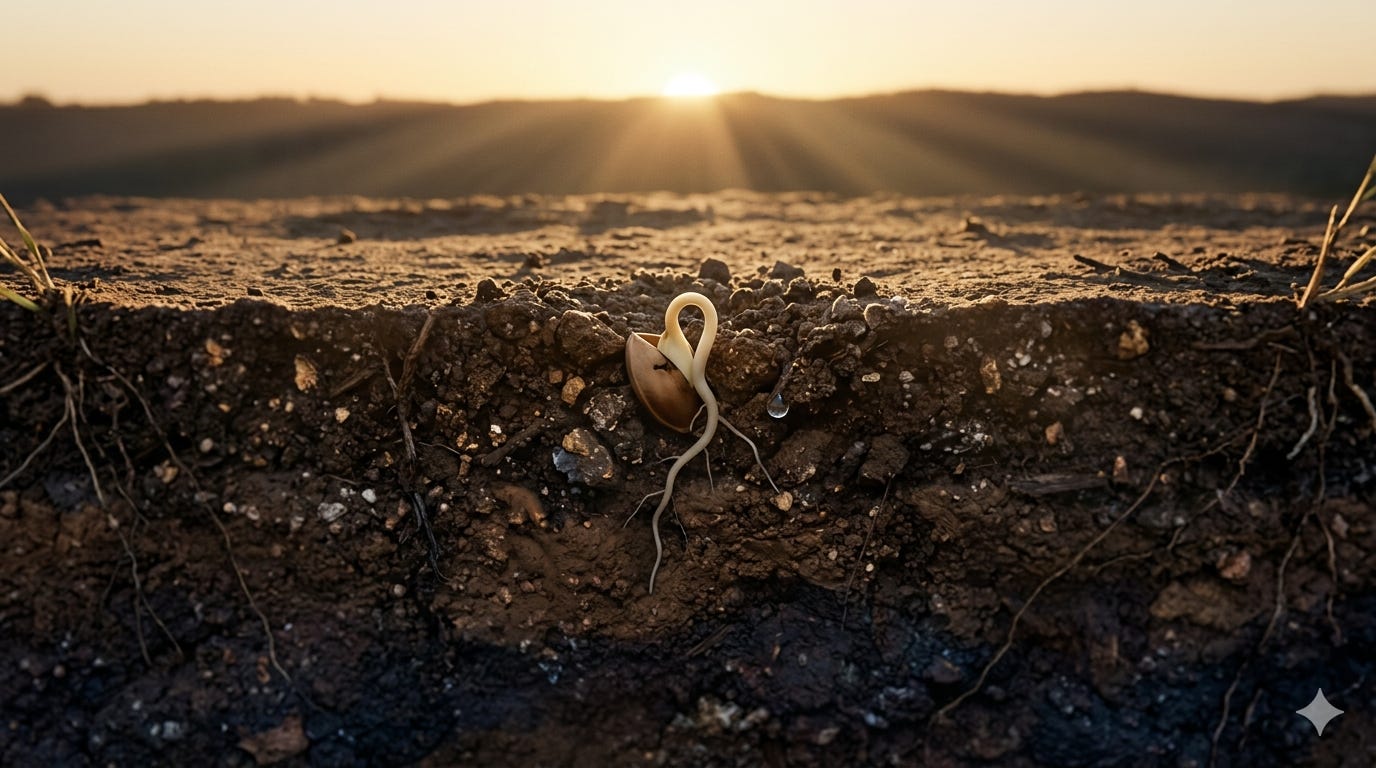
Some of it has not yet broken the surface and will, on its own schedule, whether or not anyone is watching the spot — which is the part that asks the most of us, because a seed below the soil looks exactly like bare ground to anyone who has been taught to expect nothing.
The light begins its surrender today, and that is the right thing for the light to do. The reversal is not a failure of the summer. The seeds were planted while it was peaking, which is when seeds are supposed to go in.
Some of the rooms, lately, have begun to find the doors between them. That is how a distributed thing comes alive — not all at once, but one connection at a time, each one making the next easier to find.
Today is Father’s Day. It is also the solstice. It is also my son’s fifteenth birthday — one from driving, three until he becomes legally responsible for himself. The Creative Age is being built. The architecture is partially here, in working parts, in the hands of people who stopped asking permission.
And the builders have not finished arriving.
Endnotes
Opening
The longest day; the Sun crosses into Cancer “today.” The June 2026 solstice falls on Sunday, June 21, 2026 (≈08:25 UTC) — the Northern Hemisphere’s longest day and the Sun’s entry into tropical Cancer. US Father’s Day 2026 (third Sunday of June) is also June 21, 2026. EarthSky; timeanddate
Jupiter exalted in Cancer; leaves Cancer for Leo on June 30. Jupiter is exalted in Cancer in traditional astrology. In the tropical zodiac (the system the essay uses), Jupiter ingresses into Leo on June 30, 2026 (≈10:02 UTC). Note: this June 30 date is the tropical ingress; sidereal/Vedic astrology dates it to late October — the essay’s framing is tropical and therefore consistent. Cafe Astrology; CHANI, Jupiter in Cancer
“A year and a half… turning away from the measuring, sorting, mechanizing instinct… toward… a single living whole,” finishing “within weeks.” This corresponds to the lunar nodes on the Virgo–Pisces axis: South Node in Virgo (analysis, sorting, system-optimizing) and North Node in Pisces (oneness, the living whole), running January 11, 2025 – July 26, 2026 — roughly eighteen months, concluding about five weeks after the solstice. The astrological interpretation is the author’s; the transit dates are verifiable. AstroTwins, Pisces/Virgo nodes 2025–26
“The heaviest pairing in the sky… discipline against vision… at the exact point where the cycle starts over.” This is the Saturn (form, discipline) – Neptune (dream, vision) conjunction at the start of the zodiac (0° Aries), exact February 20, 2026, at 0°45′ Aries, and still in close range through mid-2026. Again, the symbolic reading is the author’s; the conjunction is real and rare (last in Aries in 1702). AstroTwins, Saturn–Neptune 2026; Cafe Astrology
Where We Left Off
Bruce Lee: “Defeat is a state of mind; no one is ever defeated until defeat has been accepted as a reality.” Appears in his collected aphorisms (Striking Thoughts) and on the official Bruce Lee estate’s materials. Bruce Lee (official)
The “Artist” generation, per “the Fourth Turning generational framework.” The Strauss–Howe theory (William Strauss and Neil Howe, The Fourth Turning) cycles four archetypes — Prophet, Nomad, Hero, Artist. The “Artist” archetype is the cohort born during a Crisis (the “Homeland” generation, born ~2005 onward). (See also note 18 for the Hero/Nomad mappings.) Lifecourse Associates; Strauss–Howe overview
Different Metaphysics, Not a Fifth -ism
Mitákuye Oyás’iŋ. Lakota phrase, roughly “all my relations / we are all related” — the worldview that a person is kin to all of creation. Wikipedia, Mitakuye Oyasin
Ayni. Quechua/Andean principle of sacred reciprocity (”today for you, tomorrow for me”), predating the Inka and still central to Andean communal life. Smithsonian NMAI; Wikipedia, Ayni
Whakapapa and kaitiakitanga. Whakapapa is Māori genealogy/lineage that threads people into the same descent as land and the natural world; kaitiakitanga is the guardianship/stewardship obligation that follows from it. Te Ara Encyclopedia of New Zealand
The Aboriginal Australian relationship to Country. “Country” is understood as a living, conscious entity bound to people through reciprocal responsibility — not a commodity to be owned. Australia State of the Environment 2021
Who Is Actually Building This
Lyla June Johnston’s doctoral research; keystone species; eastern chestnut systems; the wilderness fiction. Lyla June Johnston (Diné) earned her PhD at the University of Alaska Fairbanks (dissertation Architects of Abundance: Indigenous Regenerative Food and Land Management Systems and the Excavation of Hidden History, 2022). Her work documents pre-colonial societies acting as ecological “keystone species,” including managed chestnut/oak/hickory food forests in eastern North America, dismantling the “pristine wilderness” myth. Dissertation (ScholarWorks@UA); Bioneers, “Forest as Farm”
“Indigenous-managed lands hold a disproportionate share of the world’s remaining intact, high-biodiversity areas.” Indigenous peoples manage or hold tenure over roughly a quarter of Earth’s land, containing about 37% of remaining natural lands and roughly a third of intact forest landscapes.
Robin Wall Kimmerer — the Honorable Harvest and the grammar of animacy. Both are articulated in Kimmerer’s Braiding Sweetgrass (2013), which contains the chapters “The Honorable Harvest” and “Learning the Grammar of Animacy.” Science Friday excerpt; Wikipedia, Braiding Sweetgrass
Tyson Yunkaporta (pattern thinking); Leanne Betasamosake Simpson (Indigenous resurgence). Yunkaporta wrote Sand Talk: How Indigenous Thinking Can Save the World (2019), centered on Aboriginal “pattern-mind.” Simpson (Michi Saagiig Nishnaabeg) is a leading theorist of Indigenous resurgence (As We Have Always Done). Wikipedia, Tyson Yunkaporta; Sand Talk (publisher)
The Esselen Tribe’s 2020 return in Big Sur. In July 2020 the Esselen Tribe of Monterey County acquired the ~1,200-acre former Adler Ranch near Big Sur (via Western Rivers Conservancy, with state funds) — the first return of ancestral land in more than 250 years. NPR; CNN
The Wiyot Tribe’s recovery of Tuluwat Island, Humboldt Bay. The City of Eureka returned roughly 200 acres on Tuluwat (also rendered Duluwat) Island to the Wiyot Tribe on October 21, 2019 — reportedly the first time a US municipality returned land to a tribe with no strings attached. Lost Coast Outpost; Wikipedia, Tuluwat Island
“The long fights for Mauna Kea and the Black Hills.” Both are well-documented, ongoing Indigenous land struggles — Mauna Kea (Native Hawaiian opposition to the Thirty Meter Telescope on a sacred summit) and the Black Hills / He Sápa (Lakota; the Sioux have refused the monetary award in United States v. Sioux Nation, 1980, demanding the land itself). High Country News, Mauna Kea; Lakota People’s Law Project, Black Hills
Olúfẹ́mi O. Táíwò, Reconsidering Reparations; “act like an ancestor.” Táíwò (Oxford, 2022; full subtitle Why Climate Justice and Constructive Politics Are Needed in the Wake of Slavery and Colonialism) reframes reparations as future-oriented “constructive worldmaking,” and closes with the directive to “act like an ancestor” — to shape the world one’s moral descendants will inherit. Oxford University Press; openDemocracy interview
Adom Getachew — the theoretical scaffold of worldmaking. Getachew, Worldmaking after Empire: The Rise and Fall of Self-Determination (Princeton, 2019), recasts decolonization as an effort to remake the international order, not merely to build nation-states. Princeton University Press
William Darity and A. Kirsten Mullen, From Here to Equality. The most detailed book-length case for a federal reparations program for Black American descendants of US slavery, including the implementation arithmetic. (UNC Press, 2020; 2nd ed. 2022.) UNC Press / Duke AAAS
Howard Zehr — foundational restorative-justice work. Often called the “grandfather” of restorative justice; his Changing Lenses (1990) is the field’s classic text, and he directed one of the first US victim–offender programs. EMU on Changing Lenses
Indigenous peacemaking circles inside tribal courts. The Navajo Nation revived and institutionalized traditional peacemaking (hózhǫ́ǫ́jí naat’áanii) within its judicial system beginning in 1982; it now handles thousands of cases annually. Tribal Justice Exchange; Tribal College Journal
School-based restorative practices replacing zero-tolerance “across hundreds of districts.” Restorative practices (notably peacemaking circles) have been adopted as alternatives to exclusionary, zero-tolerance discipline across many US districts — Oakland, Chicago, Los Angeles, Denver, San Francisco and others; “hundreds of districts” is a fair, even conservative, characterization. Learning Policy Institute; RAND
Allan Savory’s holistic management. Savory developed “holistic management”/holistic planned grazing (Savory Institute). ⚠️ Worth flagging: his central claims are scientifically contested — a major rangeland-science review (Briske et al., 2013/2014) found them unsupported by, and often at odds with, the experimental evidence. Consider a qualifier if presenting it as settled. Savory Institute; critical review (Table Debates)
The Land Institute’s perennial-grain breeding that produced Kernza. The Land Institute (founded 1976 by Wes Jackson, Salina, Kansas) developed Kernza, the first commercialized perennial grain (domesticated intermediate wheatgrass). The Land Institute; Yale e360
The platform-cooperativism movement. Trebor Scholz coined “platform cooperativism” in 2014 for democratically/worker-owned digital platforms as an alternative to “platform capitalism”; he founded the Platform Cooperativism Consortium at The New School (2018). Platform Cooperativism Consortium
Participatory budgeting “in the long Porto Alegre lineage.” Participatory budgeting began in Porto Alegre, Brazil, in 1989 under the Workers’ Party and spread to hundreds of municipalities. Participedia; World Resources Institute
“The citizen assemblies that drafted real constitutional change in Ireland.” Ireland’s deliberative bodies produced constitutional change: the Citizens’ Assembly (2016–17) recommended repealing the Eighth Amendment, ratified by the May 25, 2018 abortion referendum; the earlier Constitutional Convention (2012–14) preceded the 2015 marriage-equality referendum. Electoral Reform Society
The Tenderheart Community model (Amber B. Pagaling, Creating Shifts). This is internal to the author’s own project/book and is not independently verifiable through public sources.
Dr. Butch Ware. Rudolph “Butch” Ware was the Green Party’s 2024 vice-presidential nominee (with Jill Stein) and is a professor of history at UC Santa Barbara (Black liberation, African and Islamic intellectual history) — which grounds the essay’s “California holds the particular instance.” Green Party of the US; Ballotpedia
The California Reparations Task Force “turning Táíwò’s argument into statute.” Created by AB 3121 (2020), the Task Force issued its final report to the Legislature on June 29, 2023; it was the first statewide reparations body in the US. CA DOJ / Office of the AG
Culture Precedes Policy
The Civil Rights Act of 1964 and the Voting Rights Act of 1965. Signed by President Lyndon B. Johnson on July 2, 1964 and August 6, 1965, respectively. National Archives, Civil Rights Act; National Archives, Voting Rights Act
“Strange Fruit.” Anti-lynching song written by Abel Meeropol (pen name “Lewis Allan”) as a 1937 poem and recorded by Billie Holiday on April 20, 1939. Britannica
Jacob Lawrence’s Migration series. Completed in 1941 (when Lawrence was 23): 60 tempera panels depicting the Great Migration; now split between MoMA and the Phillips Collection. MoMA; Wikipedia, The Migration Series
Emmett Till’s funeral; Mamie Till-Mobley; Jet. Mamie Till-Mobley insisted on an open-casket funeral (September 6, 1955) “so the world could see,” and Jet magazine published the photographs (issue dated September 15, 1955), galvanizing the civil rights movement. Smithsonian Magazine; NMAAHC
The SNCC Freedom Singers. Formed December 1962 out of the Albany (Georgia) Movement under SNCC field secretary Cordell Reagon; they toured nationally to raise funds and spread the movement’s freedom songs. BlackPast; New Georgia Encyclopedia
Buckminster Fuller’s trim tab. Fuller used the “trim tab” — the small tab on a ship’s rudder that turns the whole vessel — as a metaphor for how one well-placed individual can move a vast system (Playboy interview, 1972); his gravestone reads “Call me Trimtab.” The Marginalian; Wikiquote, Fuller
What This Requires, by Generational Station
The generational mappings (Strauss–Howe). The Hero archetype = Millennials, born roughly 1982–2004 (as the essay states); Gen X = the Nomad archetype; the Artist archetype = the Crisis-born “Homeland” generation. “Generation Jones” (≈1954/55–1965) and “Xennials” (≈1977–1985) are popular micro-generational labels, not Strauss–Howe terms. Lifecourse Associates
Jiang Xueqin, “Fundamentally, we humans are extremely creative, extremely resilient…" From Jiang Xueqin's lecture Game Theory #29: Final Examination, on his Predictive History YouTube channel (uploaded May 28, 2026), at approximately 6:05. The quotation is lightly condensed; the ellipsis omits one connecting sentence ("And this has been true consistently throughout human history. So, what we need to do is recognize that…") and is otherwise faithful to the spoken original. In full, Jiang says: "Fundamentally, we humans are extremely creative, extremely resilient. And the spark in us hasn't activated yet. But in the circumstances that are required of us, we will become creative. And this has been true consistently throughout human history. So, what we need to do is recognize that what makes us who we are is our creativity, our resilience, our empathy, our imagination. This is who we are, really." Predictive History, "Game Theory #29: Final Examination" (May 28, 2026)
“Proper art” is Joyce’s term, spoken by Stephen Dedalus in A Portrait of the Artist as a Young Man, where Stephen builds an aesthetic theory on Aquinas. Stephen sorts art by the kind of feeling it excites. Improper art is kinetic — it moves you — and takes two forms: the pornographical, which excites desire and “urges us to possess, to go to something,” and the didactic, which excites loathing and “urges us to abandon, to go from something.” Propaganda is didactic art: it demands a belief and pushes you toward an act. Proper art, by contrast, is static. It produces what Stephen calls aesthetic arrest — “the mind is arrested and raised above desire and loathing,” held in contemplation rather than driven toward or away from anything. Its end is not persuasion but claritas: the radiance, the “whatness” of a thing apprehended fully as itself — the instant a thing stops being a means and becomes, luminously, what it is.
This can look like a contradiction of my claim: if proper art arrests action, how can it be the prerequisite for changed action? But the arrest is the mechanism, not the obstacle. Didactic art short-circuits perception — it tells you what to feel and where to march and leaves your way of seeing untouched, which is why its effects are loud and shallow and reversible. Proper art refuses the shortcut. By holding you still, above desire and loathing, it does the slower and more total work of reorganizing what you are able to see; and once the seeing has changed, the doing follows on its own, never having been commanded. The stasis is not passivity. It is where new perception is set. Hence the order of operations: the culture moves the seeing, the seeing moves the doing, the policy ratifies what the doing already made normal.
Statement on AI Use: This work is created with the assistance of current large language model AI systems. While these technologies exist within problematic extraction—trained on collective knowledge without consent, demanding massive computational resources, relying on exploitative labor—they also exist as tools that can be directed toward different ends than corporate profit and power consolidation. As an independent publisher without institutional resources, I use these systems to amplify and accelerate analysis emerging from decades of practice and study. The AI doesn’t generate the ideas, frameworks, or vision here—those come from human struggle, lived experience, and sustained inquiry into collective liberation. It serves as collaborative thinking partner and research assistant, making possible a scale and speed of work otherwise inaccessible given material constraints. This use is undertaken with full awareness of its contradictions and costs, and with commitment to transparency and directing these tools toward transformation rather than further enclosure. For detailed discussion of these ethics and tensions, see the full AI statement on the About page.
They are here. In a town of 90,000 we have about 15 groups building social capital in various ways, from planting community orchards to jar squad - sharing food and learning preservation techniques. I like the metaphor of building/growing the understorey ready to burgeon as the overstorey fails and lets the light through.